

Press Release
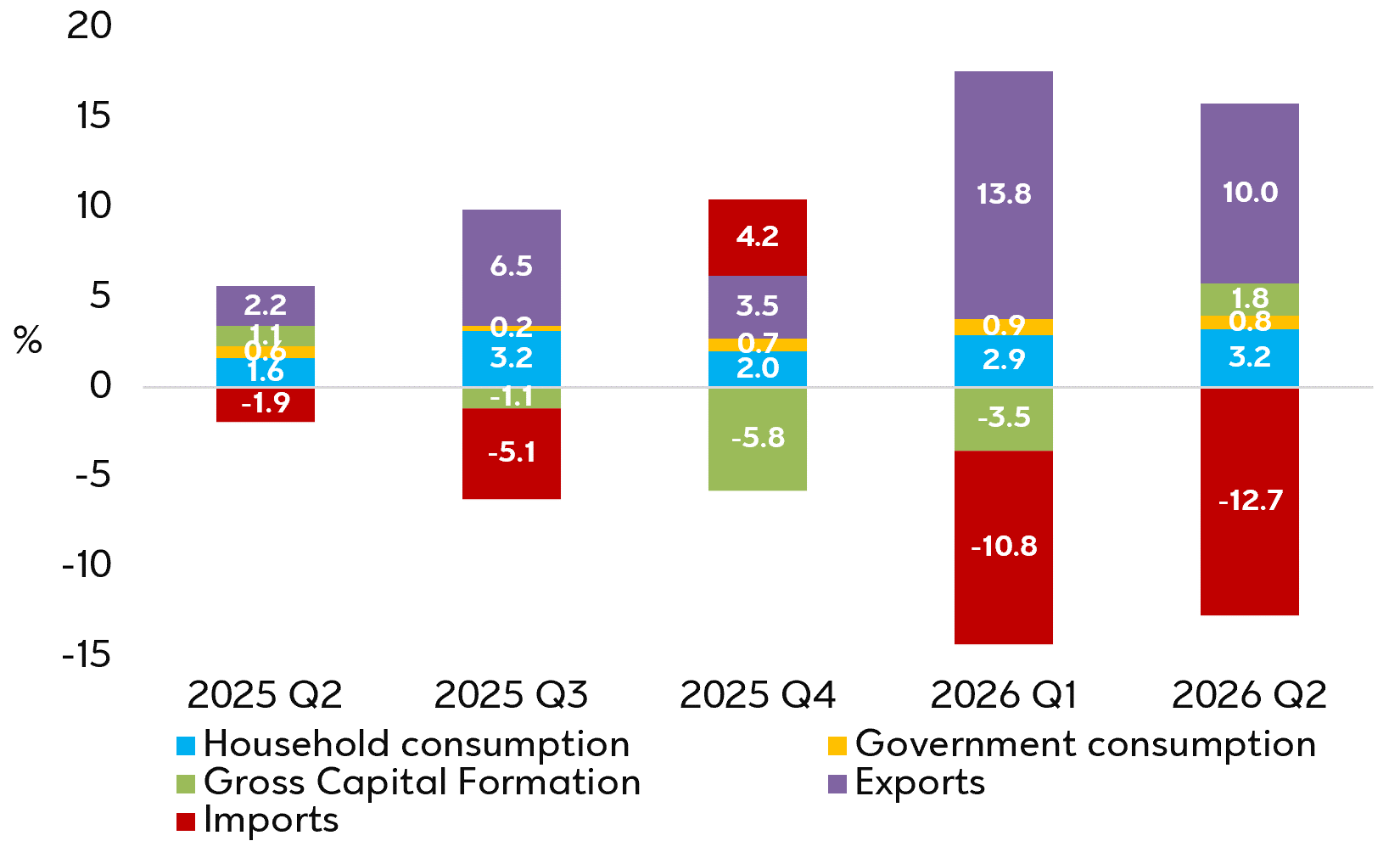
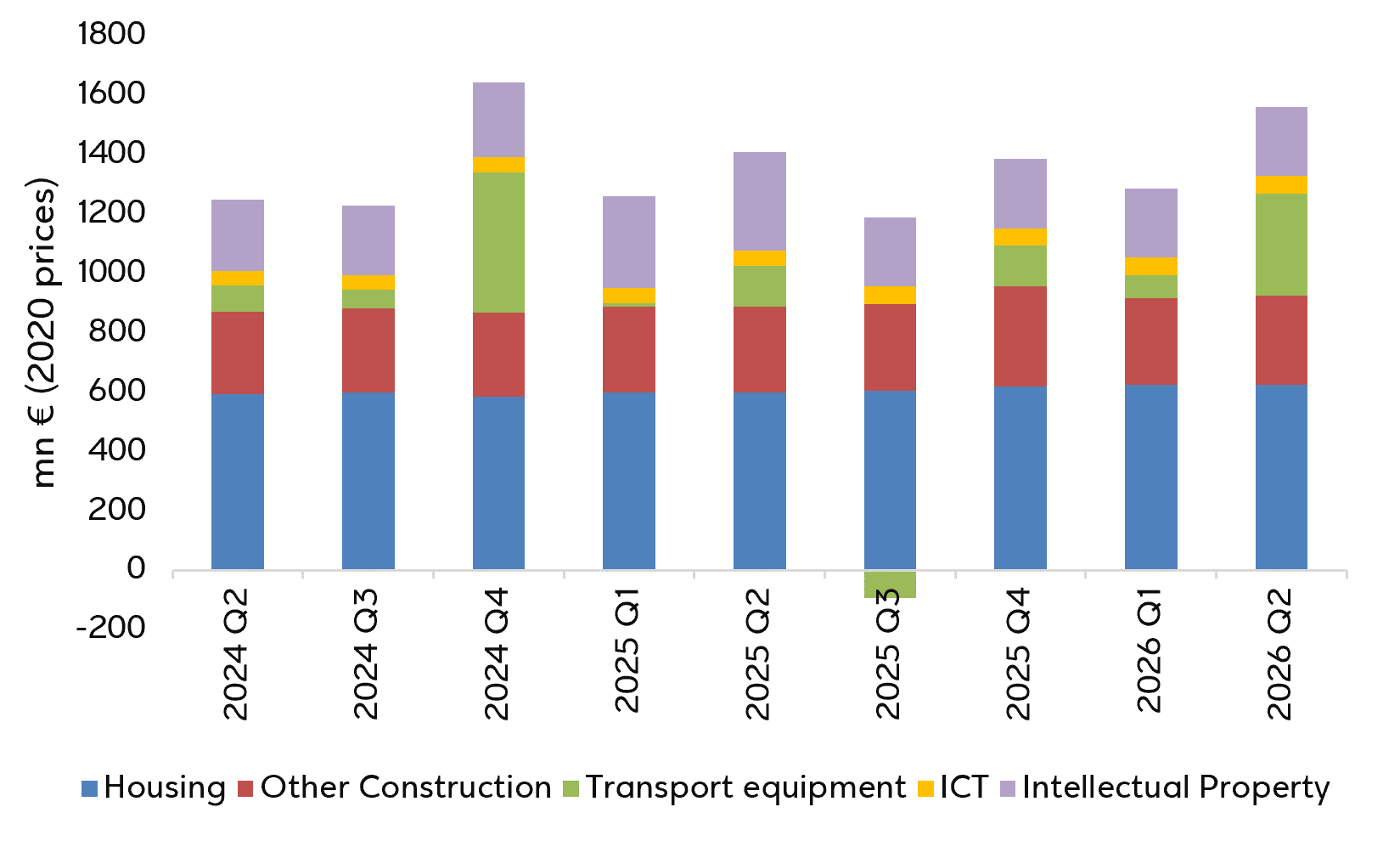
Despite the deterioration in the global economic environment following the outbreak of the US-Iran war, the Cypriot economy remained resilient in Q2 2026, with GDP growth accelerating to 3.3%YoY, from 3.0%YoY in the previous quarter. This was the fourth-highest growth rate in the Euro Area. According to the expenditure breakdown, growth was primarily driven by household consumption (+5.4%YoY) and gross fixed capital formation (+9.4%YoY). The latter was supported mainly by a surge in investment in transport equipment (+151.9%YoY), while residential investment increased at a more moderate pace (+4.3%YoY). Household spending continued to benefit from favourable labour market conditions, with unemployment remaining close to record lows for this period of the year (3.6% in Q2 compared to 3.2% in Q2 2008), alongside robust consumer credit growth (+12.0%YoY) and strong wage dynamics (+3.9%YoY in hourly wage costs, the strongest increase in five quarters). Private consumption has traditionally been a key and stable driver of Cyprus’s economic growth, with the current contribution consistent with past expansionary periods.
Government consumption also contributed positively to growth, expanding by 4.5%YoY. Exports increased by 9.6%YoY, supported primarily by services exports. Nevertheless, the external surplus narrowed by 45.1%YoY, as imports rose by 12.9%YoY, largely reflecting the aforemantioned increase in transport-related investment. Thus, despite the strong performance of services exports, the external sector acted as a drag on GDP growth as the increase in imports more than offset the export contribution. On the production side, the acceleration in GDP growth was driven mainly by higher activity in wholesale and retail trade, ICT services, financial and insurance activities, and construction.
Contribution of GDP components to growth
Source: Cystat, Eurobank Research
Looking ahead, there are signs that economic momentum remained robust at the start of Q3 despite the ongoing geopolitical tensions in the Persian Gulf. On the investment side, real estate sales increased by 10.7%YoY in July-August, bringing the year-to-date growth rate to 13.7% and placing the market on track for a new all-time high. Strong demand is also evident in residential property prices, which rose by 8.5%YoY in Q2, lifting the residential property price index to a record high. This buoyant demand is being driven primarily by non-resident buyers, who accounted for 59% of the increase in property sales during January-August. As a result, construction activity is expected to remain strong to meet demand; during January-May, an expansion of 43.1% YoY was recorded in surface terms. In addition, transport equipment and intellectual property investment are expected to support capital formation during the remainder of 2026, through base effects.
Export performance has also proven more resilient than initially anticipated. The sharp decline in tourist arrivals recorded in March-April (-28.6%YoY) moderated significantly in June (-1.7%YoY) and July (-1.1%YoY), before widening only slightly in August (-3.3%YoY). As a result, tourist arrivals were down by 7.0% YoY during January-August, broadly in line with the 4.7%-5.8% decline projected in the previous Cyprus Insights newsletter. Under this scenario, tourism activity would remain above 2024 levels despite the challenging geopolitical environment. Real estate and intellectual property services are also expected to continue providing support to exports growth.
The outlook for household consumption remains subject to opposing forces. On the one hand, inflationary pressures re-emerged in August, with headline inflation accelerating to 5.2%YoY, from 4.4%YoY in July, largely driven by higher energy prices, despite the continued implementation of energy-related support measures. These developments increase uncertainty regarding the inflation outlook once such measures are gradually withdrawn. On the other hand, labour market conditions remain broadly supportive. As noted above, the unemployment rate remained close to historical lows in Q2 despite a 9.4%YoY increase in the number of registered unemployed persons. Encouragingly, unemployment declined relative to the previous quarter even though the labour force expanded by 1.6%QoQ, with non-residents accounting for 65.1% of the increase. This suggests that Cyprus continues to attract foreign workers, an important development given the persistent labour shortages that the country needs to tackle, reflected in the still-elevated job vacancy rate (2.6% in Q2 2026). Moreover, there are signs that labour market conditions improved further during Q3, as the annual increase in registered unemployment moderated to 6.5% in July-August.
Another indication of the resilience of Cyprus's domestic fundamentals and favourable medium-term macroeconomic outlook is the recent sovereign rating upgrade by S&P to A from A-, accompanied by a positive outlook. According to the agency, the upgrade reflects the country's continued external and fiscal deleveraging, which is underpinned by strong real economic growth.
Fixed capital formation components
Source: Cystat, Eurobank Research


