

Press Release
Cyprus’s economy continues to expand, but the widening imbalance in its external accounts deserves closer attention. The current account records earnings and payments between Cyprus and the rest of the world, covering trade, investment income and transfers (e.g., from the European Commission). The Central Bank of Cyprus’s revised figures put the 2025 deficit at 8.8% of GDP, compared with 6.4% previously reported (Figure 1). By contrast, the 2024 deficit was revised to 5.5% of GDP, down from 8.2% previously reported. These changes show that the gap widened in 2025, reversing the earlier picture of improvement. Figures for the first six months of 2026 show further pressure.
The revised figures increase the 2025 current account deficit by €870 million to €3.21 billion. The largest adjustment was a €1.42 billion increase in the estimated income deficit, mainly relating to net investment income. The goods deficit was also revised up by €201 million, while net current transfers abroad were €108 million higher than previously estimated. The changes were partly offset by an €855 million upward revision to the services surplus, mainly reflecting higher estimated net earnings from ICT services.
Figure 1: Current Account revisions reverse the previously reported improvement in 2025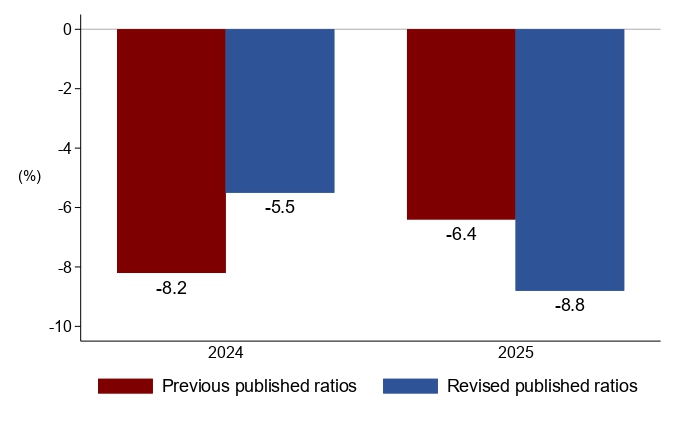
Source: Central Bank of Cyprus, Eurostat, Eurobank Research
In the first six months of 2026, the deficit reached €2.42 billion, equivalent to 12.8% of GDP for the same period, compared with 10.1% a year earlier. The gap widened by €635 million, with almost all the increase occurring in the second quarter. The goods trade deficit increased by €441 million, while the services surplus fell by €432 million (Figure 2). Services exports continued to grow, but payments for imported services rose faster. This reduced the surplus that helps Cyprus cover its goods trade deficit. Information and Communication services (ICT) recorded a €212 million fall in their surplus, despite higher export earnings. Travel and financial services also recorded smaller surpluses, down by €183 million and €230 million respectively.
The pressure therefore extended beyond tourism to other important sources of earnings from abroad. Higher net earnings from licensing, royalties and other business services provided some relief. A €333 million improvement in the income balance partly offset these pressures, while a €94 million deterioration in secondary income added to the deficit.
Figure 2: Goods and services drive the H1 deterioration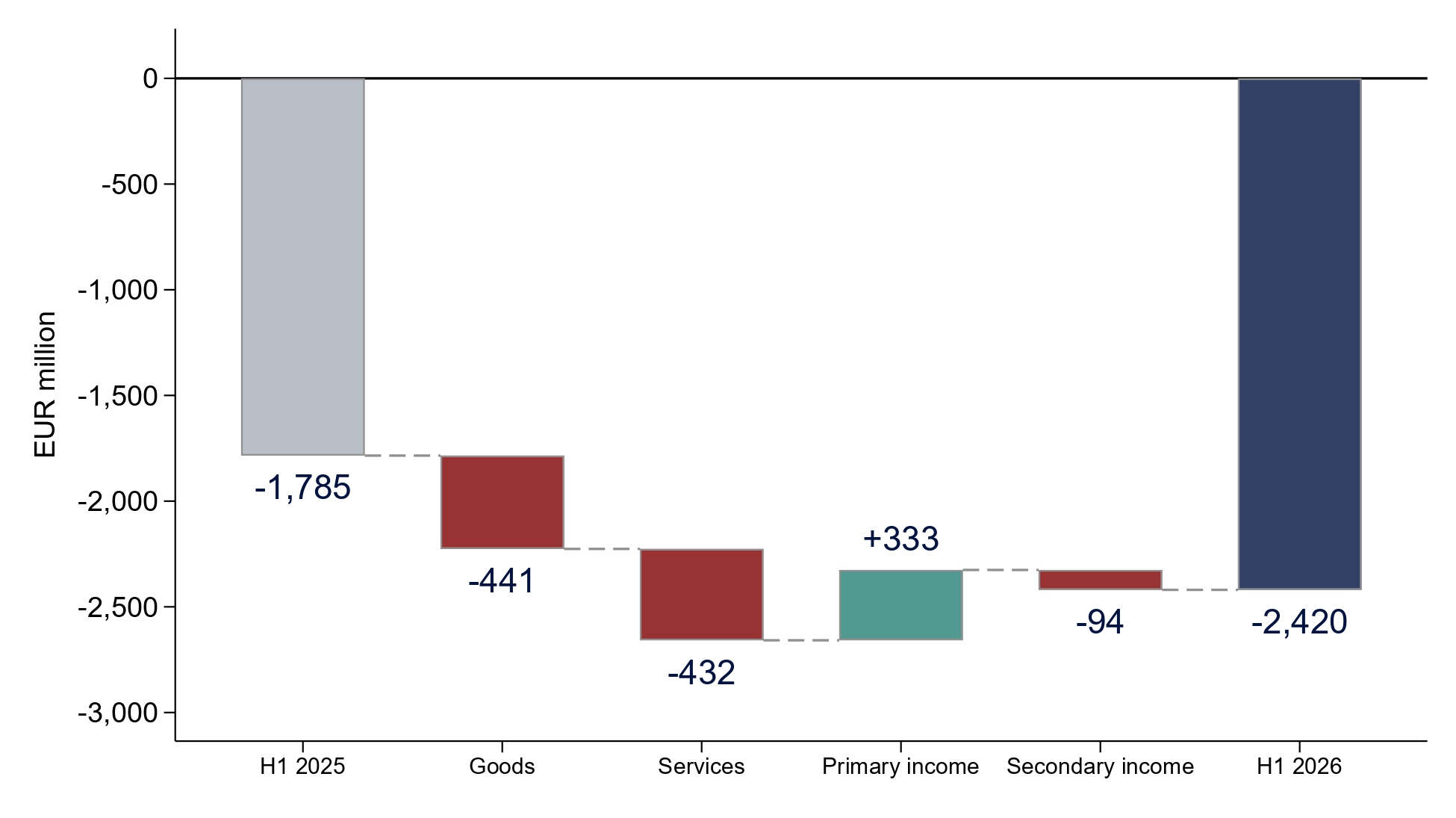
Source: Central Bank of Cyprus, Eurobank Research
Strong household spending and investment help explain the increase in imports. Detailed trade figures show that transport equipment and parts accounted for around 77% of the rise in goods imports in the first six months. Such purchases can help businesses expand and support future growth. Tourism continued to provide less support, with revenues down by 6.2% year-on-year in January-August to €2.32 billion. July’s 4.6% increase was followed by a 3.4% decline in August. The August fall mainly reflected fewer visitors, while average spending per visitor remained broadly unchanged. However, based on provisional Statistical Service data, the goods trade deficit widened further compared with a year earlier in July and August. The IMF’s October 2026 World Economic Outlook projected current-account deficit of 7.7% in 2026, using information available before the CBC’s latest revisions. In light of the updated figures, we see significant upside risk to these projections.
These developments highlight the importance of strengthening and diversifying Cyprus’s earnings from abroad as the economy grows. Household spending and business investment create demand for imports, while profits belonging to overseas investors also affect the figures. International businesses contribute to exports and jobs, so the deficit should be considered alongside their contribution to the economy. Attention should focus on how the gap is financed and whether investment helps generate future income. Over the long term, a gradual narrowing of the external deficit would strengthen economic resilience and support more sustainable growth.
Cyprus can build on its expanding services economy through the following opportunities:
- Stronger export earnings: Help businesses develop skills, introduce new products and services, and reach customers in new overseas markets.
- More opportunities for local businesses: Help local firms supply goods and services to international companies operating in Cyprus, allowing more businesses to benefit from expanding sectors.
- Less dependence on imported energy: Support viable investment in renewable energy and more efficient energy use, helping reduce the need for imported fuels over time.
- Saving and business investment: Encourage financial education and saving for the future, alongside finance that helps businesses invest and grow.


