


Dorita Yiannakou
A cup of coffee is becoming an increasingly costly habit for consumers in Cyprus, with prices for both traditional Cypriot and instant coffee climbing over the past year. Price increases across 12 coffee products exceeded 11%, according to the Commerce Ministry’s Consumer Protection Service price observatory, adding pressure to household budgets and spending. At a time when families are juggling numerous everyday expenses, increases in frequently purchased products such as coffee can make a noticeable difference.
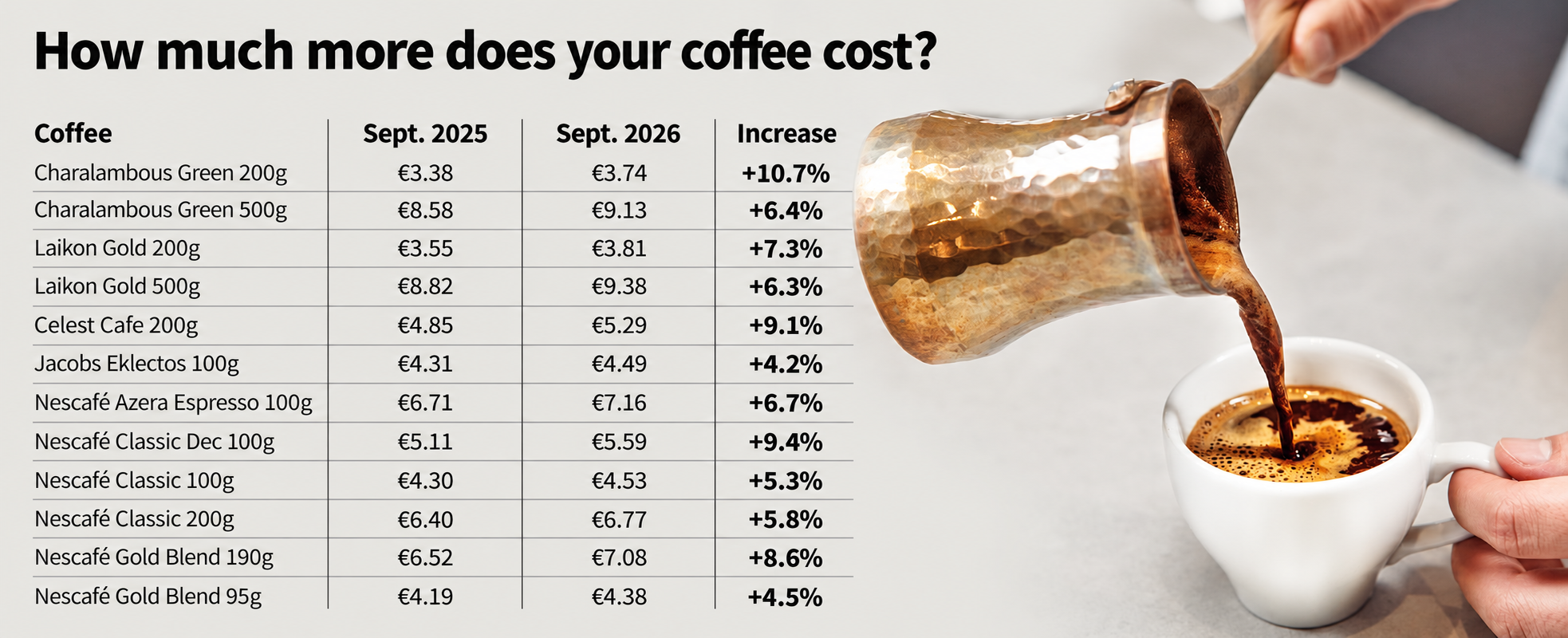
More specifically, prices for 12 coffee products in Cyprus rose between 4.2% and 10.7% in September compared with the same month last year.
Prices increased across every coffee product monitored by the ministry’s observatory.
The largest percentage increase was recorded for the 200-gram pack of Charalambous Green, which rose from €3.38 in September 2025 to €3.74 in September 2026—an increase of 36 cents, or 10.7%, in a year.
Other products and popular brands also recorded substantial increases. Nescafé Classic Dec, in the 100-gram pack, rose from €5.11 to €5.59, an increase of 9.4%, while the 200-gram Celest Cafe climbed from €4.85 to €5.29, up 9.1%. Nescafé Gold Blend, in the 190-gram pack, increased by 8.6%, from €6.52 to €7.08.
The 200-gram Laikon Gold rose from €3.55 to €3.81, up 7.3%, while the 100-gram Nescafé Azera Espresso increased from €6.71 to €7.16, a rise of 6.7%. The 500-gram packs of Charalambous Green and Laikon Gold recorded increases of 6.4% and 6.3%, respectively.
Nescafé Classic, in the 200-gram pack, rose from €6.40 to €6.77, up 5.8%, while its 100-gram pack increased from €4.30 to €4.53, up 5.3%. The 95-gram Nescafé Gold Blend rose from €4.19 to €4.38, an increase of 4.5%.
The smallest percentage increase was recorded for the 100-gram Jacobs Eklektos, which rose from €4.31 to €4.49, up 4.2% over the year.
The impact on consumers
Higher coffee prices directly affect consumers because the product is part of daily life in many households. Even when the increase per pack seems relatively small, repeated purchases push up total spending over time.
For example, someone buying one 200-gram pack of Charalambous Green each month would spend an additional €4.32 a year if the price remains at €3.74. Similarly, buying one 100-gram pack of Nescafé Classic Dec each month would cost an extra €5.76 a year compared with September 2025 prices.
The impact is greater for families that drink more coffee or households buying several packs each month. These increases add to other food and essential shopping bills, leaving less money available for other needs.
Differences in the size of the increases may also influence shopping habits. Consumers may turn to cheaper brands, larger packs or supermarket offers to keep costs down. Whether those options offer savings, however, depends on personal preferences, what shoppers can afford and the actual price per unit.
According to the observatory’s figures, buying one pack of each of the 12 products would have cost €66.72 at September 2025 prices, compared with €71.35 in September 2026. That is an increase of €4.63, or approximately 6.94%, for this particular basket of products.
A global phenomenon
Rising coffee prices are not unique to Cyprus. International developments appear to be putting pressure on the coffee market worldwide.
Weather conditions in major producing countries, such as Brazil and Vietnam, are among the most important factors affecting the global market. Drought, high temperatures, and heavy rainfall can reduce production, limiting the amount of coffee available worldwide.
According to the U.N. Food and Agriculture Organization, international coffee prices rose by 38.8% in 2024 compared with the 2023 average. The increase was linked to production problems and pressure on global supplies.
Shipping costs, geopolitical tensions, and disruptions to trade routes can also increase the cost of importing and supplying coffee. Roasting, packaging, energy, labor and distribution expenses all contribute to the final price.
International prices do not always rise, however. World Bank figures show that Arabica prices fell by almost 7% and Robusta prices by 9% in the second quarter of 2026 compared with the previous quarter, as the outlook for global supplies improved.
A fall in international coffee bean prices does not necessarily mean consumers will immediately pay less. The effect on retail prices depends on when raw materials were purchased, the stocks businesses hold, supply contracts and costs at each stage of the supply chain.
Coffee price increases may therefore have international roots, but the final cost to consumers varies from market to market.


