

Newsroom
President Nikos Christodoulides used the world’s biggest diplomatic stage Wednesday to confront Turkish President Recep Tayyip Erdogan directly, accusing Ankara of speaking about international law while doing the opposite in Cyprus.
Addressing the 81st United Nations General Assembly in New York, Christodoulides said he had listened carefully to Erdogan’s speech a day earlier, including his references to sovereignty, territorial integrity, occupation, and the suffering of refugees.
He then turned those words back on the Turkish leader.
The president said politicians should be judged by their actions, not their speeches, and challenged Erdogan to follow the principles of the U.N. Charter he had quoted from the same podium.
For Cyprus, it was the sharpest moment of an address built around one central complaint: International law cannot be defended loudly in one conflict and quietly ignored in another.
Fifty-two years, and the same questions
Christodoulides reminded world leaders that 52 years have passed since Turkey’s 1974 invasion and that more than one-third of the Republic of Cyprus remains under Turkish occupation.
He referred to displaced families still unable to return home, relatives who continue to seek answers about missing loved ones, and Varosha, which remains sealed despite U.N. Security Council resolutions.
These are familiar subjects in Cyprus, repeated through generations and across countless diplomatic meetings. But that was also the point of the president’s message: The passage of time, he argued, does not make the occupation, or the U.N. decisions concerning it, any less relevant.
For the average Cypriot, this is where the polished language of the United Nations becomes personal. Behind phrases such as “territorial integrity” are family homes left behind, villages people know only through photographs and questions that remain unanswered more than half a century later.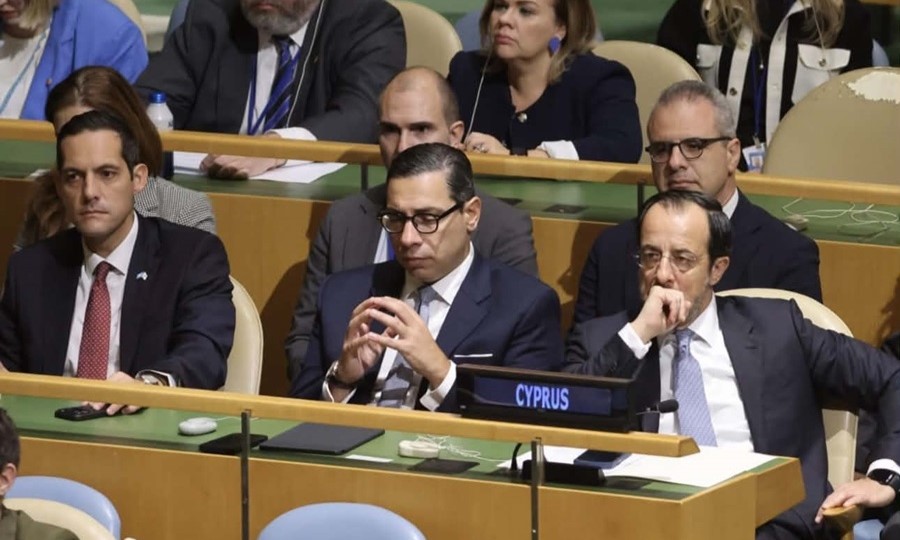
No to partition, yes to talks
Christodoulides firmly rejected any permanent division of the island, declaring, "Division will not be accepted.”
He reaffirmed that a bizonal, bicommunal federation with political equality remains the only U.N.-agreed basis for a comprehensive settlement.
The president said he was ready to restart negotiations from where they ended in 2017 and build on the work already completed. In his view, the framework and common ground already exist; what is missing is the political will to return to serious negotiations.
He appealed to Turkish Cypriots to view a shared future as an opportunity for peace and prosperity. He then placed the responsibility squarely before Erdogan, urging him to approve substantive negotiations within the agreed U.N. framework.
The challenge now is whether the strong words will produce movement beyond the General Assembly hall. Cyprus has heard declarations of readiness before, while formal negotiations have remained frozen since the collapse of the Crans-Montana talks in 2017.
Christodoulides’ address also set the stage for his meeting Thursday with U.N. Secretary-General António Guterres, where the next steps on the Cyprus problem are expected to be discussed.
Cyprus as more than a divided island
The speech was not confined to the Cyprus problem.
Christodoulides sought to present the country as a small state that can still play a useful role in a dangerous neighborhood. He highlighted Cyprus’ position between Europe, Asia and Africa, arguing that while major powers have size and influence, smaller countries can build partnerships and bring different sides together.
He pointed to the Amalthea maritime corridor for delivering humanitarian assistance to Gaza and said Cyprus had dedicated more than a quarter of its humanitarian aid budget to Palestine.
He also said Cyprus had helped evacuate thousands of people from 70 countries during regional emergencies over the past three years, repeatedly serving as a safe transit point when conflict erupted nearby.
Other examples included the regional aerial firefighting station at the Paphos air base and the Cyprus center, established with the United States, that trains government officials in land, maritime, and port security.
Christodoulides also referenced Cyprus’ six-month presidency of the Council of the European Union, noting that a country of fewer than 1 million people had been tasked with helping steer a bloc of about 450 million.
His broader message was that Cyprus should not be seen only as a small, divided island asking the international community for help. It also wants to be viewed as a country capable of offering help when the region is in trouble.
But the speech inevitably returned to the contradiction at the heart of Cyprus’ foreign policy: a country that promotes international law, humanitarian cooperation, and regional security while still waiting for international law to be enforced at home.
Christodoulides made his case clearly before the United Nations. The harder part begins after the applause, turning another forceful speech in New York into something Cypriots can actually see changing on the ground.


