

Newsroom
A 60-year-old man went to a private clinic with severe abdominal pain and vomiting. By the next morning, his right leg hurt and felt numb, and his foot was cold. He spent another night at the clinic before an ambulance took him to Limassol General Hospital. By then, the damage to his leg was irreversible.
Fifteen years later, Cyprus’ Court of Appeal unanimously upheld a €314,612.38 damages award, finding that the doctor’s failure to act in time contributed to the gangrene that led to the below-the-knee amputation. In its Nov. 20 ruling, the court rejected all six grounds of the doctor’s appeal.
The man was admitted to the clinic on Sept. 5, 2011, with a suspected gallbladder problem. The court found that the clinic failed to carry out the tests needed to confirm that diagnosis or respond promptly as symptoms in his right leg worsened. A vascular surgeon was called, but the doctor left it to the patient’s relatives to try to persuade the specialist to come that evening, according to the trial court’s findings.
The specialist examined him the next morning, and the patient was transferred to Limassol General Hospital. A scan revealed an 8-centimeter blood clot in an artery supplying his right leg. Surgeons removed the clot and part of his small intestine, but they could not save the leg. It was amputated the following morning.
Why the ruling stood
The appeals court acknowledged that the trial court lacked scientific evidence for its conclusion that a faster referral would have saved the man’s leg and bowel. The judges upheld the award because they found that the delay had materially contributed to the harm. They also agreed that the circumstances called for the doctor to provide a satisfactory explanation and found that he had offered none that pointed to another cause.
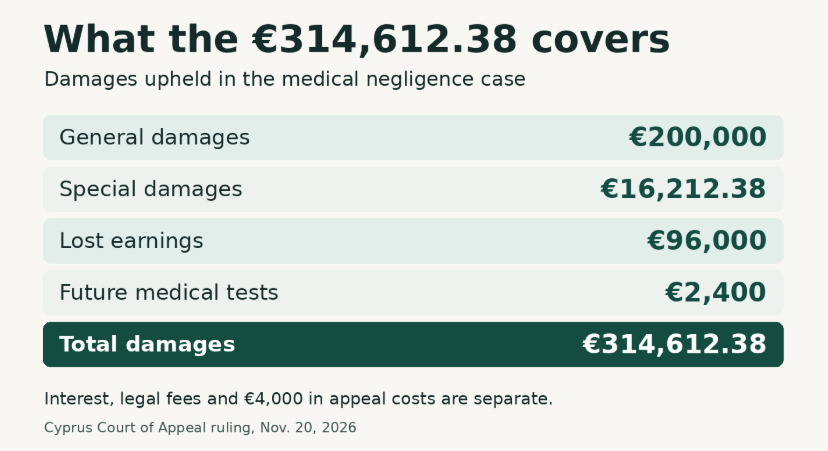
Interest and legal fees are payable in addition to the damages. The court also ordered the doctor to pay €4,000 in appeal costs, plus VAT if applicable.


