


Oriana Papantoniou
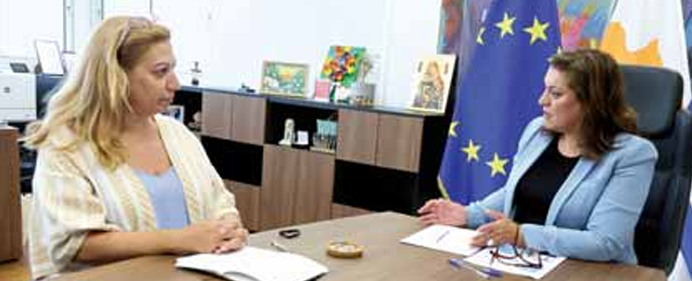
“We have an ambitious plan, but we are fully prepared to begin evaluating teachers as soon as schools reopen,” Education, Sports and Youth Minister Athina Michaelidou said in an interview with Kathimerini.
“What we need is the necessary support from teachers themselves,” she added.
"What do you consider the biggest challenge facing you?: --"Resistance to change."
Michaelidou said it was surprising that some organisations had already rejected the ministry’s proposal for changing the teacher appointment system before it had even been discussed.
She also made clear that the ministry has no intention of considering the abolition of morning prayer in classrooms.
At the same time, she said it would benefit the country if teachers and the ministry could be seen working together in the interests of children.
Q: What are the Education Ministry’s priorities for the 2026-27 school year?
It will be a year of change and action on many levels. We are putting into practice policies designed over previous years and evaluating innovations that have already been introduced.
At the same time, we are expanding these policies and adding targeted measures so that we can produce results that can be measured.
Our priorities include the teacher appointment system, special education, changes to teaching in the classroom, and a broad plan covering school buildings and infrastructure, with a focus on health and safety.
This year, we are also introducing a fifth study stream at lyceums, expanding technical lower secondary schools, and bringing in an upgraded citizenship education program.
There will also be new programs, along with earlier prevention and diagnosis beginning at the kindergarten level.
Q: How will you measure the results?
We have introduced pupil assessment across the entire education system.
Diagnostic tests are perhaps our main assessment tool, together with alternative forms of evaluation.
In secondary education, we have added projects and other assignments that give pupils more opportunities to carry out research, experiment and work creatively.
We are conducting our own tests rather than relying only on external assessments, whose results can take time to improve.
Q: Is the ministry continuing to update the curriculum to reflect today’s needs?
Of course. This is one of our main educational goals.
Reducing the amount of material pupils are expected to cover, while adding and strengthening skills, are among the main changes being made to the curriculum.
From this year, we have managed to bring what is taught in secondary schools into line with what pupils are assessed on. This has been a long-standing goal.
Q: How many schools will take part in the pilot program for social workers?
The contracts were signed recently. Based on identified needs, the program will operate in three lower secondary schools and two primary schools in the Nicosia and Limassol districts.
This is a very important decision with a clear social purpose.
The social worker’s role will be to improve communication with families and help provide children with more complete support, working alongside everyone else involved.
The program will operate on a trial basis for one year. Once it has been assessed, we will decide whether to expand it to more schools.
Teacher appointments
Q: Does the ministry have a clear position on how to move from the existing teacher appointment list to the new system?
We have presented a framework for discussion and made it clear that we are open to dialogue, changes and amendments.
We find it surprising that some organisations have already taken a negative position before the proposal has even been discussed.
We deliberately described it as a working document. We are not approaching this in a one-sided or authoritarian way.
We are also in contact with the Legal Service and will return with an updated document after recording the views of the organisations involved.
If some have already made up their minds without any discussion, that is extremely problematic.
The proposal supports people who are already working within the system. For the first time, it recognises previous teaching experience as an important factor and corrects problems within the examination system.
Q: Could the existing process be extended, or will the ministry submit legislation this year even without agreement from all sides?
There is no reason for an extension because we would simply be discussing the same issues again in two or five years.
A 10-year transition period is already coming to an end.
After discussions with everyone involved, it is the ministry’s duty to amend the existing legislation with the aim of creating a high-quality education system.
Q: Could changes to the appointment process weaken the quality standards introduced through the examination system?
Not under the proposal we have presented. On the contrary, it protects quality.
There have been problems with the examinations. That is why I say that long transition periods create established interests and a sense of entitlement.
Clear decisions must be made so that we can move forward, assess the results and make improvements where necessary.
There must be an examination, as there is in the wider public sector. But it should test abilities and skills rather than memorisation.
We believe that combining theory with practical ability will give us the best-quality teachers.
Teacher evaluations
Q: Are there any gaps that could prevent teacher evaluations from being introduced on schedule?
We are following the law and the timetable exactly.
Training has already taken place, while the monitoring committee has discussed the relevant job descriptions.
We are ready to begin formative evaluation, meaning continuous internal assessment aimed at helping teachers improve.
We have taken into account the legislation providing for new inspector positions in 2027 and 2028.
For now, however, we have made the necessary arrangements so that existing inspectors can carry out the formative evaluations without pressure or difficulties.
Senior teacher positions will also be introduced in 2027-28. Until then, the law allows experienced teachers to take on senior duties in exchange for a reduced teaching schedule.
Q: So, will teacher evaluations begin as soon as schools reopen?
It is an ambitious plan, but we are fully prepared.
What we want is the necessary support from teachers.
The unions are represented on the monitoring committee, meaning we will assess the process together. We will correct any problems or weaknesses while strengthening the parts that work well.
Implementation is extremely important because that is when any problems will become clear.
The message currently being given is that there is resistance to every change, and that does not help the system.
Changes are necessary. We want them because we want better results from our education system.
Q: When do you expect the results to become visible?
Once schools introduce internal systems that support and strengthen teachers without creating anxiety, communication with school management will improve.
This will help prevent problems while also highlighting good practices. The school becomes a learning community.
Improving pupils’ academic results will take time. The way people work will change, weaknesses will be identified through evaluation, and training will then be provided according to the needs that emerge.
We will monitor all this without targeting individual schools, teachers or headteachers. The aim is improvement.
All-day schools
Q: Are there enough teachers to staff the new all-day schools?
Working with the POED teachers’ union, we have offered full-time and part-time contracts to a large number of teachers.
We now have 383 all-day schools.
What matters to us is not only that their number is increasing, but also that their quality is improving.
There is a clear link between the morning and afternoon programs. An all-day school is not simply somewhere to keep children occupied or supervised.
It has a proper curriculum that includes continuous and creative work, along with the development of skills, so that children gain educationally from attending.
Q: Every summer, parents face a long period during which they must find someone to care for their children. Is the ministry considering offering more support, given that summer schools operate only on certain dates?
The law governing the beginning and end of the school year has been in place for many years.
We are beginning a discussion about daily school hours. In the same way, we will also discuss the length of the school year with everyone involved.
This will be done with full respect for the needs of society and the views of our partners.
Morning prayer and special education
Q: Why must morning prayer take place inside classrooms?
This law has been in force for decades, and, I must say, it has not caused any problems so far.
Anyone belonging to another religion has the right to request an exemption from religious education, although this does not happen very often.
Many parents know about this right because they are informed of it. At the same time, children are quietly allowed to pray according to their own faith where that applies. There is mutual respect.
We have schools where 90% of the pupils come from migrant backgrounds. Many activities are organised so that these children do not feel excluded.
Where isolated problems arise, whether because of behavior or a lack of understanding, we are here to resolve them.
Q: Would the ministry consider a proposal to abolish prayer in schools?
No, there is no such intention.
The primary school regulations, which include morning prayer, have already been discussed in Parliament, and its abolition was not accepted.
Q: Beyond issuing circulars, what practical measures are being taken to deal with violence and delinquency in schools?
Apart from strengthening the role of counsellors and form teachers, one important measure is the introduction of social workers, which I believe will help greatly.
A special guide has also been developed for school management teams, setting out practical ways to take action against violence and delinquency.
The measures introduced over previous years appear to have made a difference. We are also seeing results in schools where cameras have been installed.
We are encouraged that statistics show children are speaking out and trusting their schools enough to report violence they experience at home.
Q: Reforming special education was one of your original priorities. Where does that stand?
We plan to submit the relevant legislation to Parliament within the next few weeks, following two years of consultation.
The same law has been in place for 30 years. It is therefore understandable that schools are not always welcoming or accessible to children with disabilities, because they are operating under an outdated framework.
The new legislation will make schools more inclusive, placing the child at the center.
It will introduce individual programs and improve structures, timetables, training and, of course, the support provided to children themselves.
At the first stage, all children will be given the opportunity to enrol in a mainstream classroom unless their parents choose another option.
Q: What do you consider the biggest challenge facing you?
Resistance to change.
We may all agree that change is needed, but as soon as we try to put it into practice, there is opposition.
Moving forward requires collective responsibility, political will, and determination.
If the goal is genuinely to serve the child’s best interests, then there is no problem. You move ahead, and those who want to follow will do so.
If people have other objectives, things become much more difficult.
For us, it is clear: schools exist first and foremost for children, and education is a responsibility shared by society.


