

Newsroom
By Vassilis Nedos and Manolis Kostidis
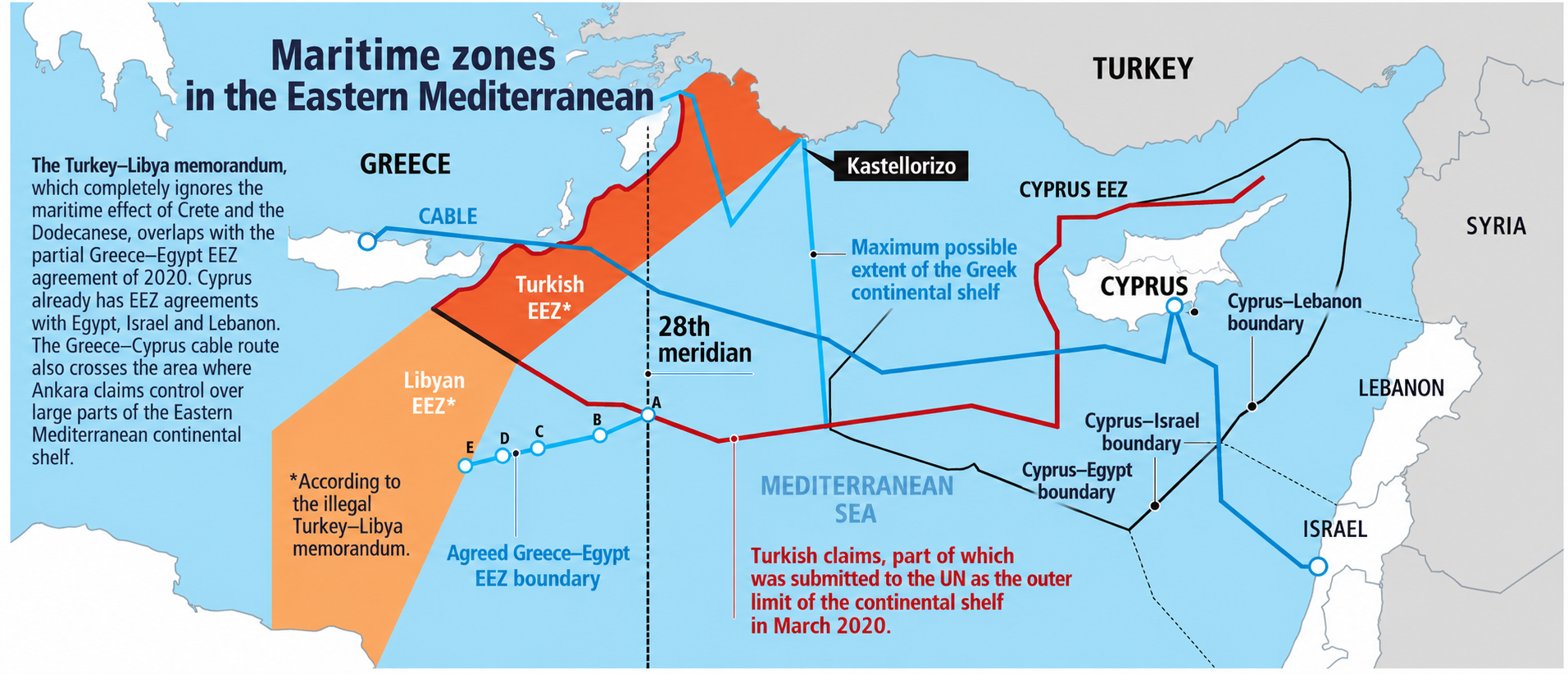
The Libyan parliament’s ratification of the illegal Turkey–Libya maritime agreement signals that Benghazi, following Tripoli, is now aligning itself with Ankara. Athens responded by warning that it would take “every appropriate action,” while planning for the Great Sea Interconnector electricity cable continues.
A high-stakes poker game is unfolding in the Eastern Mediterranean. Turkish authorities yesterday issued a NAVTEX maritime notice for the EMC data cable, with Athens preparing a similar move. It is worth recalling that the Turkey–Libya agreement did not prevent Greece from reaching agreements with U.S. energy company Chevron south of Crete.
Benghazi ratifies the illegal agreement
Greece will take “every appropriate action to safeguard its sovereign rights” following the ratification of the Turkey–Libya maritime agreement by Libya’s Benghazi-based House of Representatives.
The response came from the Greek Foreign Ministry after the move by Benghazi, effectively controlled by the faction of Field Marshal Khalifa Haftar and his sons, caught Athens off guard. Ankara’s strategic maneuver on the Eastern Mediterranean chessboard comes as Athens prepares to restart the Greece–Cyprus electricity interconnection project.
The latest developments, and Libya’s alignment with Turkey, put an extension of Greek territorial waters around Crete to 12 nautical miles back on the table.
As events unfolded in Benghazi yesterday, Ankara issued another NAVTEX, this time covering surveys by the vessel Kobi Ruegg for the EMC data cable off Cyprus. Greece will also issue a NAVTEX for the project, which will span much of the Mediterranean.
Ratification of the Turkey–Libya agreement brings options such as extending Greece’s territorial waters around Crete to 12 nautical miles back into consideration. Athens currently has no meaningful foothold in Libya, either in Tripoli or Benghazi.
It also suggests that the much-touted policy of maintaining “open channels” with both sides in Libya was rather ill-defined from the outset. Nevertheless, the Turkey–Libya agreement did not stop Greece from reaching agreements with Chevron south of Crete.
Although ratification by Benghazi does little to change Greece’s position on the agreement’s legality, it clearly confirms concerns voiced in recent months that the Haftar faction is moving into Ankara’s orbit. That applies particularly to Saddam Haftar, the army’s deputy commander and leading contender to succeed his father.
Saddam Haftar enthusiastically welcomed ratification yesterday, saying the agreement would “help defend Libya’s rights and economic interests in the Eastern Mediterranean while expanding cooperation and investment opportunities with Turkey.”
Nor is it a coincidence that, in recent months, Benghazi has conveniently avoided coordination over the increased number of migrants departing eastern Libya for Crete.
Too much weight has been placed on the replacement of Aguila Saleh by Al-Salihin al-Obeidi as speaker of Libya’s parliament in explaining the agreement’s ratification. Other factors have also played a part.
Benghazi’s approval highlights Egypt’s declining influence, even though the maritime boundary set out in the agreement also affects Egyptian interests. Egypt appears to be left outside efforts to reunify Libya, in which Turkey seems to be playing an increasingly active role.
Last April, U.S. Central Command, CENTCOM, organized the Flintlock ’26 exercise, during which forces from Tripoli and Benghazi appeared under a joint command and also worked with Turkish forces.
According to well-informed sources speaking to Kathimerini, Athens has become aware that Turkey and the United Arab Emirates are jointly playing a leading role in efforts to unify the armed forces of eastern and western Libya. Turkey and the UAE are not necessarily working at cross-purposes. Israel, too, has attempted to extend its reach into Benghazi.
All of this is also tied to Libya’s internal political maneuvering. Saddam Haftar has presidential ambitions in a reunified Libya, and Turkey appears to be signaling support for a possible candidacy.
Meanwhile, Greek Foreign Minister George Gerapetritis has spoken with several counterparts, particularly Egypt’s Badr Abdelatty. According to the Egyptian Foreign Ministry, their discussion covered, among other issues, “the escalating challenges in the region, with particular emphasis on the situation in Libya in light of recent events.”


