

Newsroom
Could people classified as “native” become a minority in some European countries within a generation?
A demographic model published by the Institute for Remigration puts that possibility on the table—with Switzerland crossing the halfway mark in 2038, Belgium in 2044, and Germany in 2045.
But understanding those dates means looking closely at who is being counted.
The institute’s “migrant” category does not simply mean foreigners arriving from abroad. Depending on the country, it includes naturalized citizens and people born and raised there who have a family migration background. Nor does it distinguish a single nationality or community set to become a majority.
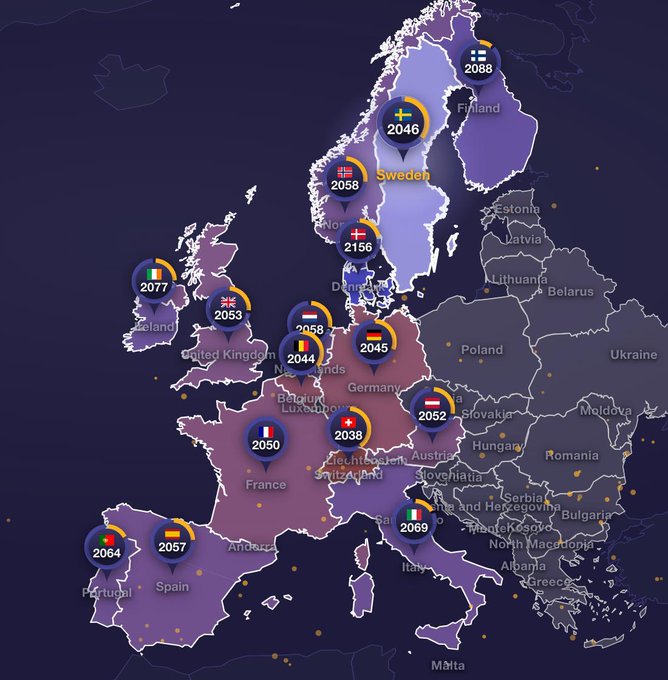
In Belgium, for example, the model includes Belgian citizens with a foreign background, including those with one foreign-background parent. In Austria, its definition covers people whose two parents were born abroad. The Austrian projection crosses 50% in 2052. These differing definitions make comparisons between countries less straightforward than the headline suggests.
The model follows assumptions about births, deaths, and migration over time. Newborns are assigned to their mother’s population category, while assimilation is not included in the calculation. That means the figures cannot, by themselves, tell readers how future generations will identify culturally or nationally.
The project also has an explicit political purpose. The institute advocates preserving a “native” majority and presents an alternative scenario involving sharply reduced immigration and additional departures. It is therefore a policy advocacy project, rather than an official European population forecast.
France requires another qualification. Its estimated 2050 threshold comes from a separate organization’s high scenario, not the institute’s own model. The dashboard acknowledges that it is not directly comparable with the other countries’ results.
Population projections can help governments plan. But dates decades into the future depend on assumptions that may change. Eurostat describes its own projections as “what-if” scenarios, rather than forecasts of what will happen.
The distinction matters: projecting a majority with a migration background is not the same as predicting that most residents will be foreign nationals—or that people born in a country will cease to regard it as home.


