


Apostolos Kouroupakis
The complexity and deep distortions of Cyprus’ fuel market become clearest when we shift our focus from the national picture to the differences between districts.
Figures for 2023-2026 confirm a clear, structural divide in how companies and petrol stations set their prices. Nicosia remains the cheapest district, while Paphos is stuck with the highest prices on the island. The persistent gap of 3 to 4 cents per litre may seem small at first glance. Over a year, however, it adds up to a substantial and unfair burden on households and businesses in Paphos.
Recent figures from the Retail Fuel Price Observatory illustrate the divide. Nicosia consistently records the lowest average price nationwide, with 95-octane unleaded petrol, for example, at around €1.689 per litre. Larnaca and Limassol sit in the middle, while Paphos remains the most expensive district, typically charging around 3 to 4 cents more per litre than Nicosia.
When consumers and local organisations in Paphos complain about this permanent premium at the pump, oil companies offer the same familiar explanation: logistics and road transport costs. Their argument is straightforward: “Paphos is far away.”
Transport and logistics costs
Petrol and diesel reach filling stations across Cyprus through the terminals at the Vasiliko Energy Hub, between Larnaca and Limassol.
Fuel is handled mainly through two types of facilities.
The first is the VTT Vasiliko terminal, or VTTV. Owned by international group VTTI, it is the largest private fuel storage and distribution terminal in the Eastern Mediterranean. Many fuel suppliers operating in Cyprus lease storage space there or purchase fuel through the terminal to supply the domestic market.
The second is terminals owned by the oil companies themselves. Petrolina’s privately owned facility is a case in point: an investment worth tens of millions of euros, with 18 tanks, used exclusively for unloading, storage and the automated loading of the company’s fuel tankers.
Paphos is by far the most distant city from the energy hub, at 94 kilometres, compared with just 25-30 kilometres for Limassol and around 45-50 kilometres for Larnaca and Nicosia. It therefore bears the higher cost of daily fuel deliveries, with each tanker making a round trip of almost 190 kilometres. That adds significantly to the costs faced by companies and petrol station operators in the district — and, inevitably, to the price consumers pay at the pump.
Paphos vs. Paralimni
Yet a careful examination of actual road distances from the island’s central supply point undermines that explanation, exposing a striking geographical and pricing paradox.
While Paphos records the highest prices, the same is not true of the government-controlled Famagusta district, which is only a few kilometres closer to Vasiliko. Filling stations there consistently charge less, with prices closer to the averages in Nicosia and Larnaca.
Fuel Price Observatory figures for October 2026 show that the highest prices for 95-octane unleaded in Paphos frequently approach the top of the market, at around €1.829 per litre. Even the district’s lowest prices rarely fall to the levels found elsewhere. At filling stations in Paralimni, Ayia Napa and Deryneia, meanwhile, consumers can find cheaper options much more easily, with the average price noticeably below that of Paphos.
More filling stations within a small area: In the government-controlled Famagusta district, towns and communities such as Paralimni and Ayia Napa are close together. Filling stations are almost side by side, allowing drivers to switch within a couple of minutes if they spot a lower price. That forces operators to squeeze their profit margins.
Paphos’ geographical spread: Paphos covers a large area, including many remote villages and mountain communities. With few alternative filling stations nearby, many consumers cannot easily shop around. That reduces the pressure to lower prices across the district.
The approach of independent filling stations: Some stations in the Famagusta district consistently pursue more aggressive discounts, prompting the major chains operating nearby to follow suit. In Paphos, prices tend to be more uniform — and higher.
The comparison matters because it shows how different factors combine to determine the final price. Distance from Vasiliko increases distribution costs, but the concentration of filling stations, consumers’ ability to choose and local pricing strategies can be equally influential.
These differences need systematic monitoring, rather than a single explanation. They also undermine the notion that transport costs alone determine pump prices, showing consumers that local competition carries far more weight than the cost of tanker deliveries.
Nicosia vs. Paphos
Two main factors help explain the gap.
Competition: Nicosia has the largest number of filling stations and, crucially, the greatest concentration of independent or smaller operators, creating intense price competition. Paphos has fewer stations, making it easier for prevailing pricing patterns to dominate and reducing the incentive for aggressive discounts.
A shortage of cheaper alternatives: Even the cheapest filling station in Paphos often charges more than the Nicosia average. This also explains why Nicosia consistently has the widest gap between its highest and lowest prices: Drivers who shop around can find cheaper fuel.
Road distances from Vasiliko and differences in fuel prices
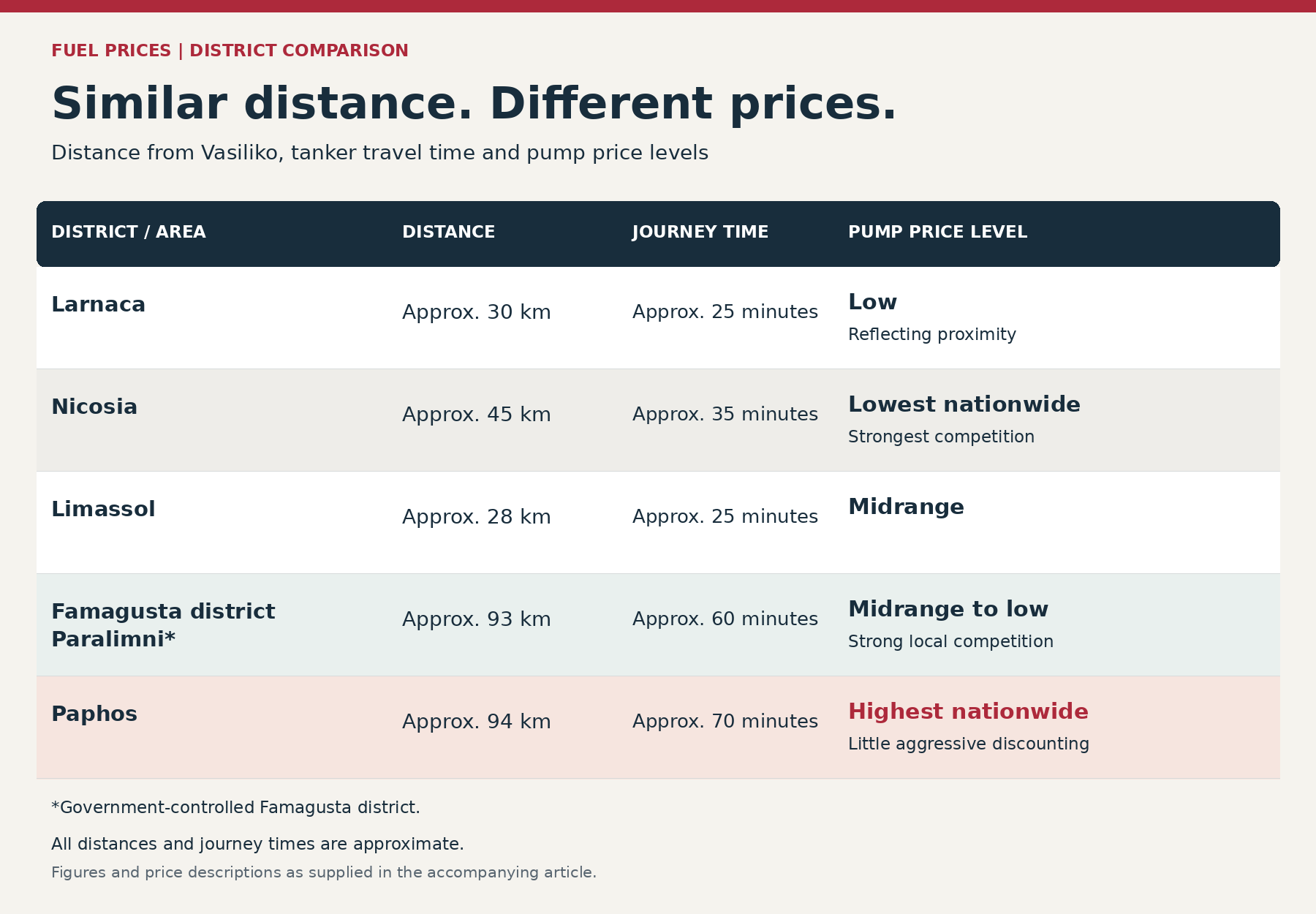
The table exposes the contradiction: Although Paphos and Paralimni face exactly the same transport costs from the central supply point at Vasiliko, consumers in Paphos pay considerably more. Distance does not justify the premium, directing attention squarely toward the way local competition operates.
Taxes, relief and the bill
Responsibility for the current system stretches back through successive governments. The present administration did not create Cyprus’ energy isolation or its dependence on private cars. It is, however, responsible for demonstrating that its policies can change that reality.
Its effectiveness cannot be measured solely by the size of the relief packages it announces. It must also be judged on whether it reduces the need for further relief in the future.
Around 40% of the final pump price consists of taxes — VAT and excise duty. That has fuelled a fierce political debate, with opposition parties and consumer organisations repeatedly calling for across-the-board reductions.
The government’s response has been limited to temporary extensions of excise duty cuts, providing relief that is itself temporary. The support package, including electricity subsidies and assistance for mountain communities, is considered inadequate. Meanwhile, the Finance Ministry is pressing the European Commission for more room in the budget to provide support as winter approaches, with heating oil at €1.66-€1.67 per litre leaving households increasingly desperate.
Extensions to electricity subsidies and targeted tax cuts always come with an expiry date. That leaves households facing constant uncertainty, unable to plan their spending over the longer term.
The gap facing mountain communities is particularly striking. Although necessary, support payments do not cover the actual cost. Residents need twice as much heating oil because of the altitude, while also having to travel long distances to towns for work or medical care. They effectively pay a double premium at the pump.
Ultimately, Cyprus’ biggest problem is not simply the price of petrol. It is how dearly people pay for the state’s failure to free them from their dependence on it — and how much more they will continue to pay while the government treats the consequences rather than the causes.
… And electric cars still struggle to gain ground
While the government highlights its efforts to contain fuel prices, the figures on electric vehicles tell a different story.
Fully electric cars accounted for just 4.2% of passenger vehicle registrations in the first nine months of 2026, down from 4.7% in the same period of 2025. Hybrids, by contrast, increased their share sharply, from 44% to 53%, taking more than half the market.
The picture becomes more revealing when set against public demand for government grants.
In the fourth application round, in December 2025, 6,428 applications were submitted for grants to buy new electric cars for private use. Just 380 grants of €9,000 each were available — almost 17 applications for every grant.
That mismatch does not mean every applicant would ultimately have bought a car. It does, however, show that interest far exceeded the funding available in that round. Across all categories, the scheme had a budget of €5.62 million for 520 grants.
Meanwhile, in May 2026, the Transport Ministry announced the installation of 11 rapid charging stations at key locations across the island. Expanding the charging network is essential to wider electric vehicle adoption. On its own, however, it cannot make buying and running an electric car affordable for the average household.
Cyprus therefore presents an unusual picture: Consumers are turning to hybrids in large numbers, but the shift to fully electric vehicles remains limited. While the state intervenes to temporarily reduce petrol bills, the possibility of breaking free from the pump remains within reach of only a small part of the market.
The strong response to earlier grant schemes, alongside the limited uptake of fully electric cars, illustrates the difficulties of that transition.
The government nevertheless plans to return with a new electric vehicle subsidy scheme in early 2027, offering more targeted support. The move acknowledges that the incentives need adjusting.
Whether it makes electric vehicles genuinely affordable for more households will depend on the eligibility criteria, the amounts available and the number of grants — as well as the continued expansion of charging infrastructure.


