

Newsroom
Turkish Cypriot representative Ünal Üstel has called on German Bundestag member Maximilian Krah to support efforts to end the international isolation of the Turkish Cypriot community during a meeting in the occupied areas on Wednesday. Krah is visiting at the invitation of the Turkish Cypriot politicians and was received by Üstel at the "Prime Ministry". "Labour and Social Security Minister" Oğuzhan Hasipoğlu and "MP" Hasan Taçoy also attended the meeting.
Üstel said Krah's visit was an opportunity to see conditions in the occupied part of Cyprus firsthand and gain a direct understanding of the Turkish Cypriot community's experience. He argued that Turkish Cypriots had paid a heavy price during decades of conflict while continuing to express support for a settlement. According to Üstel, the community has faced embargoes and international restrictions since 1974. “The Turkish Cypriot side has always done its part for a settlement. However, no result has been achieved for years due to the Greek Cypriot side’s uncompromising stance and its approach of disregarding the Turkish Cypriot people,” Üstel said.
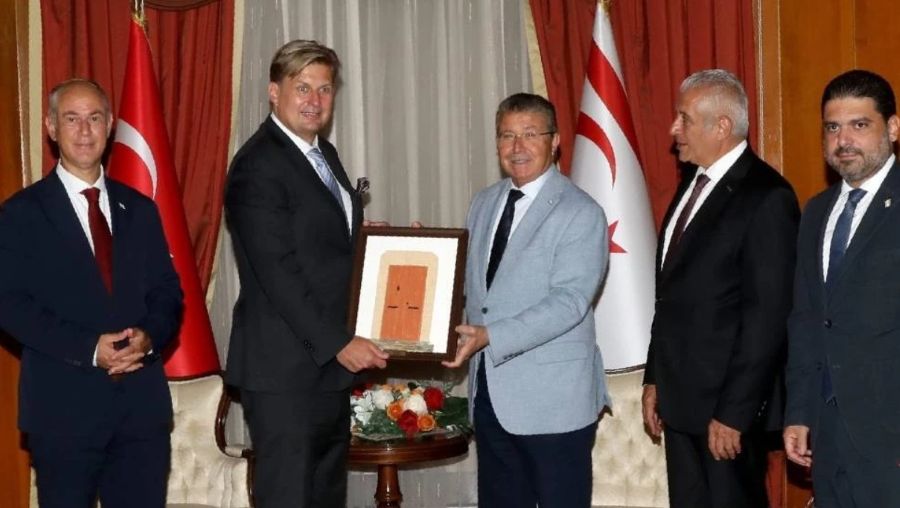
Üstel rejected a return to previous settlement formulas, arguing instead that any future agreement would require what he described as the recognition of Turkish Cypriot sovereign equality and equal international standing.
He also criticised the European Union's position on the Cyprus problem, saying Turkish Cypriots should not continue to face what he called political and economic isolation. “Our expectation is very clear: Listen to the Turkish Cypriot people, see the reality on the ground and lend your voice to ours so that the unjust isolation imposed on us can come to an end,” Üstel said.
Krah, for his part, said it was wrong to approach the Cyprus problem by hearing only one side. The German lawmaker said he was aware of steps taken by Turkish Cypriots in previous settlement efforts and of the historical experiences that have shaped the community's position. He also encouraged people to visit the occupied areas themselves rather than relying solely on accounts from one side, saying firsthand experience was important in understanding the situation on the island.


