

Martha Kehagias
While housing has become one of Europe’s most pressing social and economic challenges, Cyprus tells a markedly different story. New data from Eurostat’s Housing in Europe - 2025 edition reveal that the island consistently ranks at, or near, the extremes of several key housing indicators, often outperforming the EU average and even many comparable Mediterranean countries.
Plenty of space – almost too much
Cyprus records the lowest overcrowding rate in the European Union, with just 2% of the population living in overcrowded homes. This is a stark contrast to countries such as Romania (41%) and Latvia (39%), where overcrowding affects more than a third of residents. The EU average stands at 17%.
Yet Cyprus also sits at the opposite extreme when it comes to under-occupied housing. Seven in ten people (70%) live in homes considered too large for their household size, the highest share in the EU. Ireland (67%) and Malta (64%) follow closely, while Romania (7%) and Latvia (10%) again sit at the bottom of the scale.
This unusual combination reflects a defining feature of Cyprus’ housing stock: large homes occupied by relatively small households, often older couples whose children have moved out.

Housing remains affordable – unlike much of Europe
As many European households struggle with rising rents and mortgage payments, Cyprus emerges as the most affordable housing market in the EU by several measures.
In 2024, Cypriot households spent just 11% of their disposable income on housing, the lowest share among all Member States. The EU average was 19%, while Greece topped the list at 36%.
Housing cost pressure is also minimal. Only 3% of city residents and 1% of rural residents in Cyprus spend more than 40% of their income on housing, among the lowest figures recorded. By contrast, nearly one in three city dwellers in Greece face such a burden.
Perhaps most striking is Cyprus’ long-term price stability. Between 2010 and 2024, house prices did not increase overall, making Cyprus one of only two EU countries, alongside Italy, to avoid price growth. This stands in sharp contrast to Hungary, Estonia and Lithuania, where prices more than tripled over the same period.
A social divide beneath the surface
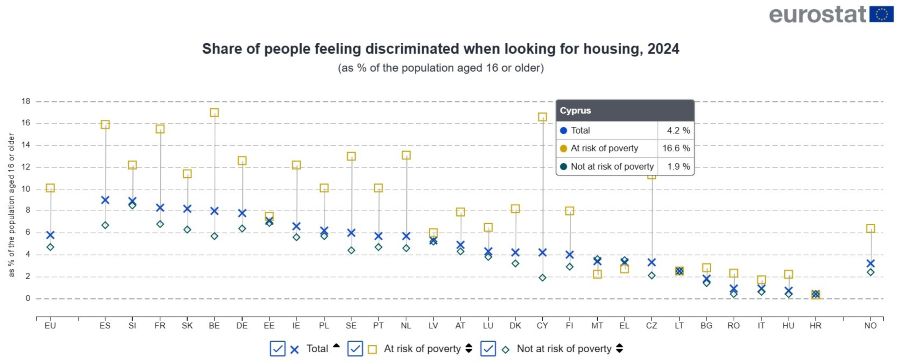
While the overall picture is positive, the data also highlight areas of concern. Cyprus shows one of the largest gaps in perceived housing discrimination between income groups.
Eurostat data reveal a sharp social divide: while only around 2% of Cypriots not at risk of poverty report housing discrimination, the figure jumps to 17% among those at risk, one of the widest gaps in the EU.
Investment without inflation
Despite stable prices, Cyprus is investing heavily in housing. In 2024, 8% of GDP was invested in residential construction, the highest share in the EU. Germany and Italy followed at a distance, while countries such as Greece and Poland invested less than 3%.
At the same time, construction costs in Cyprus rose by just 25% between 2010 and 2024, among the smallest increases in Europe. Across the EU, construction producer prices increased by 56%, and by more than 140% in Bulgaria and Romania.
This combination of high investment and low cost inflation sets Cyprus apart from many fast-growing housing markets elsewhere in Europe.
A housing outlier in Europe
Taken together, the figures paint Cyprus as a housing outlier within the EU: homes are spacious, costs are low, prices are stable and investment is high. Unlike many European countries grappling with affordability crises, Cyprus has largely avoided runaway price growth.
However, the data also suggest that efficient use of housing stock and social inclusion may become the next challenges, as under-occupation rises and vulnerable groups face barriers in accessing housing.


