

Newsroom
In 2024, European Union countries imported a massive €3.47 trillion worth of services from non-EU partners, according to new Eurostat data. The headline figure confirms the EU’s deep reliance on global expertise, but the detail reveals something more interesting: Cyprus is among the bloc’s most distinctive service importers.
Across the EU, the dominant channel for importing services remains commercial presence (mode 3 - foreign companies operating through subsidiaries inside EU countries). This accounted for 58.9% (€2.04 trillion) of all service imports last year. In 22 member states it was the primary route, with particularly high shares in Bulgaria (81.7%), Hungary (78.1%) and Spain (74.5%). Much of Europe, in other words, still prefers services delivered by firms physically established on its territory.
Cyprus, however, follows a different pattern.
The island recorded one of the highest shares of cross-border supply (mode 1 - services delivered remotely from abroad) in the EU at 43.8%, second only to Greece’s striking 68.8%. Sweden (37.7%) and Denmark (37.4%) also showed relatively high levels, but most EU countries were far lower, with Hungary and Croatia near the bottom.
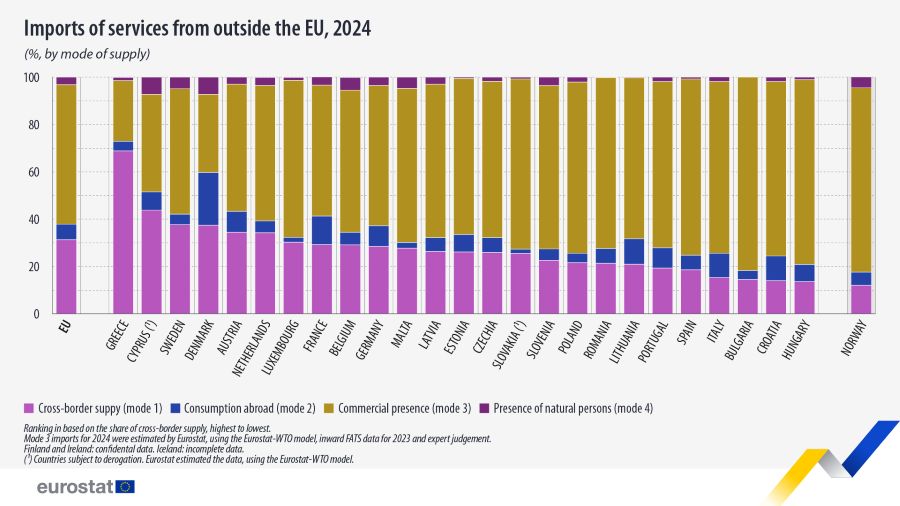
This matters because it highlights Cyprus’ role as a digitally connected, service-driven economy. Rather than relying primarily on foreign firms to set up local subsidiaries, Cyprus imports a large share of expertise directly across borders. For a small, open economy with a strong professional services sector, that flexibility is a structural feature, not a temporary trend.
Cyprus also stands out in another category that often receives less attention. The presence of natural persons (mode 4 - professionals temporarily travelling to the country to provide services) reached 7.3%, the highest share in the EU alongside Denmark. In most member states this mode plays only a minor role. The relatively strong Cypriot figure reflects the island’s dependence on internationally mobile professionals, consultants and specialised service providers who travel to deliver work on the ground.
By contrast, consumption abroad (mode 2 - residents travelling overseas to consume services) remains modest across most of the EU, accounting for 6.6% overall. Denmark is the clear outlier at 22.3%, with France, Lithuania, Croatia and Italy also posting double-digit shares. Cyprus does not feature prominently here, underlining that its services profile is driven more by business and professional flows than by outbound tourism spending.
Taken together, the data portray Cyprus as something of a hybrid services hub. It is more digitally oriented than many Central and Eastern European economies, more reliant on mobile expertise than most large member states, and less dependent on foreign subsidiaries than the EU average. That combination reflects the island’s economic model: small, open, internationally networked and heavily focused on professional and financial services.


