

Kathimerini Greece Newsroom
Written by Dora Antoniou and Manolis Kostidis
By Dora Antoniou
Athens sees the publication in the Turkish Official Gazette of the presidential decrees by which Ankara declared marine parks in two areas as a clear step up in the push to force through the Turkish revisionist agenda in the Aegean and as the finishing of the shift away from the “calm waters” approach. One park sits in the North Aegean, in the sea between Lemnos and Samothrace. The second sits in the Eastern Mediterranean, surrounding Kastellorizo and cutting it completely off from Rhodes.
The restrictions on fishing and navigation in the areas in question and the extreme version of the “Blue Homeland” bill
The government and the Foreign Ministry have already started preparing responses. First priority goes to briefing the EU and international organizations on the illegality of Turkey’s actions under international law and on the attempt to create faits accomplis while pushing unfounded claims and demands under the cover of environmental protection. A strong diplomatic demarche to Ankara is also expected.
At the same time Athens is weighing the facts and watching the Turkish leadership closely to decide whether the declaration of the marine parks is a one-off step that, under one reading, aims mainly to please the domestic audience after Greece’s own moves: the declaration of marine parks, Maritime Spatial Planning, the recent deal with the Meridiam group on the Greece-Cyprus electricity interconnection cable, and the effort to build closer ties with Libya.
Still, the new Turkish step does not go unnoticed. Diplomatic sources note that it arrives as a carefully planned action in a long chain of steps through which, steadily and over decades, the story of disputes and claims in the Aegean and Eastern Mediterranean has been constructed.
With the marine park in the North Aegean, Turkey essentially repeats its stance that the median line should be drawn from the mainland coasts alone, ignoring the Greek islands entirely. The park stretches between Samothrace and Lemnos, in international waters and inside Greece’s potential continental shelf, an area Ankara has claimed since 1973 by granting exploration licenses to the Turkish Petroleum Corporation (TPAO) after deposits were found off Thasos.
In the same way, the marine park in the Eastern Mediterranean isolates Kastellorizo from the rest of Greece’s island chain and reduces the island’s weight in setting maritime zones.
The main question is what steps might come next. One clearly bad and very troubling possibility, which would mark a major escalation, is that Ankara could later impose bans on the ground. That would mean starting to restrict activities such as fishing, exploration or navigation inside the areas it has labeled marine parks.
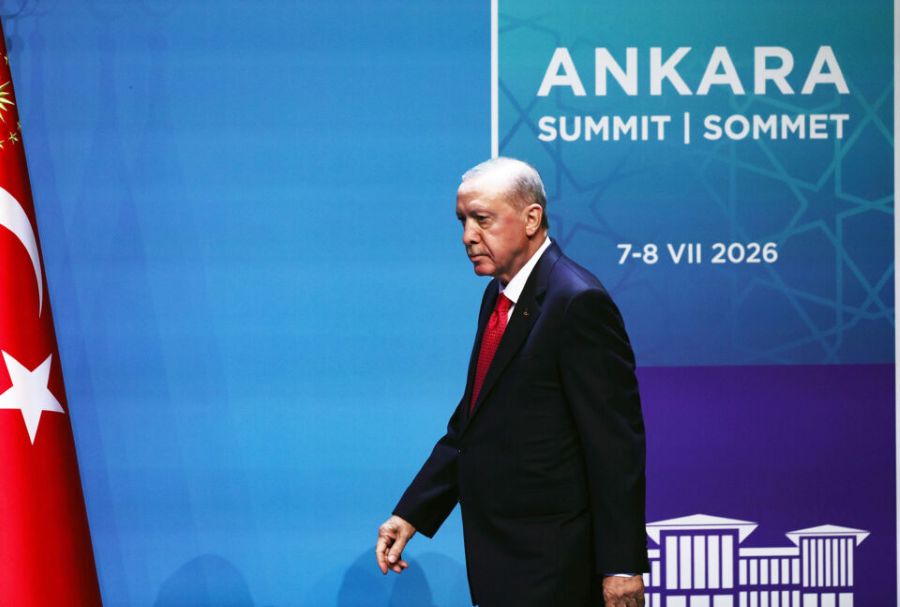 Turkey's President Recep Tayyip Erdogan shortly before a press conference in Ankara on the sidelines of the NATO Summit in July. Diplomatic sources note that the Turkish step arrives as a carefully planned action in a sequence of steps through which, gradually and over decades, Ankara has built its claims in the Aegean and Eastern Mediterranean. [EPA/NECATI SAVAS]
The second, still worse possibility is that the “Blue Homeland” itself could become law in the coming period. Over the past two days, after the declaration of the two marine parks, Turkish media have again reported that debate on the “Blue Homeland” bill in the Turkish parliament is expected in October. Those reports describe legislation that would set out by maps the boundaries of the Exclusive Economic Zone and the continental shelf that, in Ankara’s view, form Turkey’s maritime borders, along with the legal rules the Turkish side would apply inside its claimed areas of jurisdiction and maritime zones.
Athens answered the new Turkish provocation at once. In a Foreign Ministry statement it stressed that the two marine parks declared by Ankara stretch beyond Turkish territorial waters and that their creation is illegal because they occupy international waters and because they reach into the Greek continental shelf. The statement also said that Turkey’s unilateral creation of marine parks, including in areas outside its jurisdiction, cannot create faits accomplis or affect in any way rights that flow from international law.
If the Turkish step is read as a reply to Greece’s declaration of two marine parks in the summer of 2025, the contrast is total and clear. The marine parks in the southern Cyclades and the Ionian lie entirely inside Greek territorial waters.
Turkey’s next step: the “Blue Homeland”
By Manolis Kostidis
Istanbul – Correspondence. Ankara holds that it has the right to declare marine parks around Kastellorizo and in the northern Aegean. Foreign Ministry officials say that with Erdogan’s recent presidential decree, “Turkey’s positions were formalized through the two marine national parks, which had been registered on 2 August 2025 as ‘Marine Protected Areas’ on Turkey’s maritime spatial planning map, which had been announced on 16 April 2025 and registered on 12 June 2025 with UNESCO and the Intergovernmental Oceanographic Commission (IOC)”.
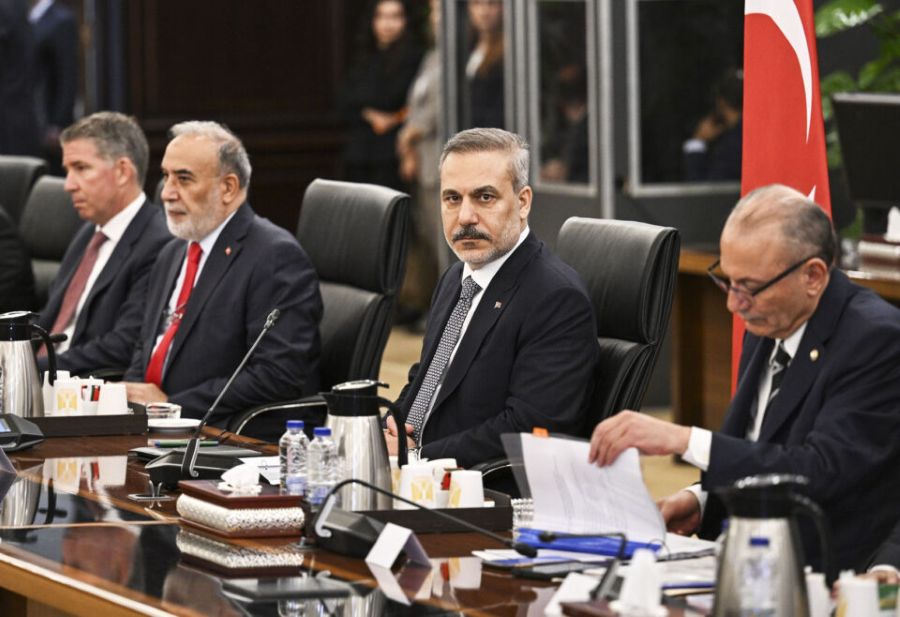 An image from Hakan Fidan’s recent meeting with the Egyptian Foreign Minister in El Alamein. The provocative language on the Cyprus issue, the Mecca agreement and the Turkish Foreign Minister’s tours are creating intense concern in Athens about Ankara’s steps.
Turkish Foreign Ministry officials told “K” that “the North Aegean and Fethiye-Kaş Marine National Parks are located, respectively, in the Aegean and the Mediterranean, within the boundaries of Turkey’s maritime jurisdiction areas and, therefore, are compatible with Turkey’s legal position regarding its maritime jurisdictions. In addition, the declaration of the two marine national parks reflects the priority Turkey places on protecting the marine environment in its neighbouring seas, not only within Turkish territorial waters, but also, in accordance with international law, in maritime jurisdiction areas beyond territorial waters”.
The Turkish theory
The Turkish side recalls the theory of the “Blue Homeland” as well as the questioning of the sovereignty of Greek islands in the Aegean. Turkish officials said that “the Foreign Ministry had already announced that the marine parks announced by Greece in 2025 would have no legal effect for Turkey, within the framework of the interconnected issues of the Aegean, including the status of islands, islets and rocky islets whose sovereignty has not been ceded to Greece through international treaties”.
Nevertheless, in the Turkish capital experienced analysts judge that the Turkish government’s decision is probably tied to the Greek government’s decisions on marine parks in the Aegean and to the spatial planning framework for tourism, which had also covered islands whose Greek sovereignty Ankara disputes.
Turkey’s Foreign Ministry spokesman, Oncu Keceli, said on 8 August that “the Special Spatial Planning Framework for Tourism announced by Greece, which also covers the Aegean Sea, will have no legal consequence for Turkey within the framework of the interconnected issues of the Aegean between the two countries, including certain geographical features whose sovereignty was not ceded to Greece through international treaties”. Experienced analysts stress that this step by Ankara is a forerunner to the approval of the “Blue Homeland” bill, which is expected to reach the Turkish parliament in the coming months.
Meanwhile, Recep Tayyip Erdogan said in an interview with the Al Jazeera television network that joining the EU is not a priority for his country, adding: “We keep telling the EU: It will not be Turkey that loses, but you”.
Speaking of relations with the United States, the Turkish president said: “We expect Mr Trump to keep the promise he made on the issue of the F-35 aircraft. He has promised us the F-35s and the fulfilment of this promise is important for Turkey; we are waiting for this promise”.


