

Newsroom
The Audit Office has identified serious problems with the long-running project to install air conditioners in schools. According to a report by the Audit Office, four of the five schools it visited still had essential work pending, despite the Education Ministry having reported that air-conditioning work at those schools had been completed.
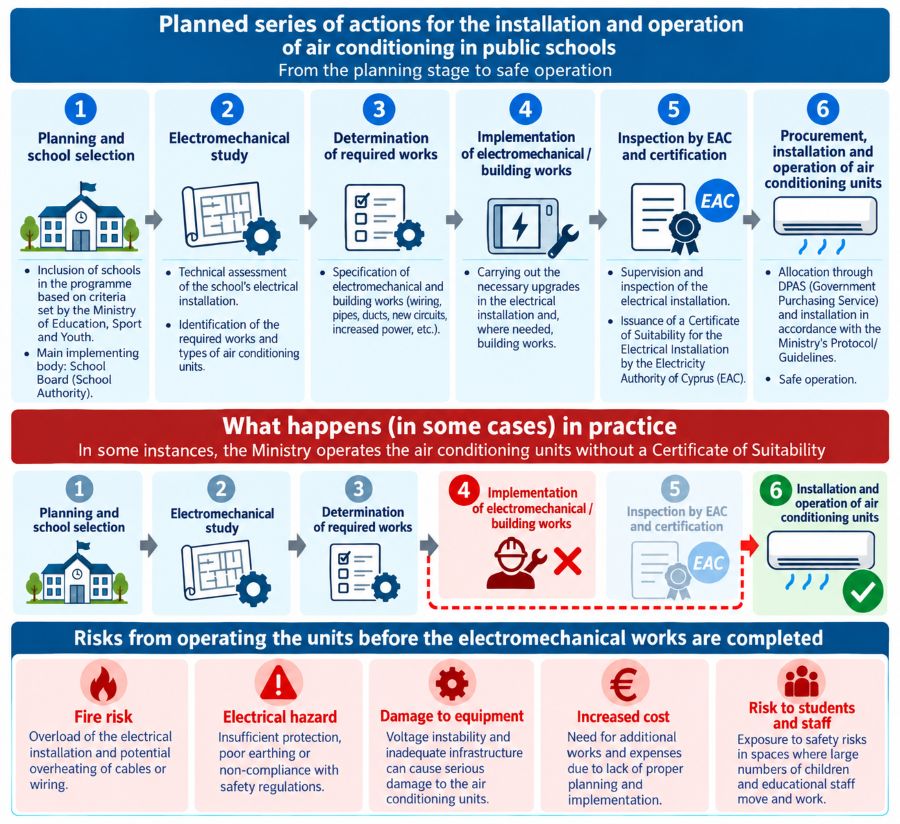
In particular, the Audit Office found air-conditioning units that had been installed for almost two years but were still not connected. In one case, a protective switch tripped and had to be reset seven times in a single day. The report found that air conditioners had been put into operation before the electrical installations had undergone the required testing and certification, as well as the final inspection and approval.
The Audit Office found the following:
- Air conditioners had been installed for almost two years, with their warranties nearing expiration, but had not been connected.
- Air conditioners were being operated on a rotating basis to prevent the electrical system from becoming overloaded.
- Makeshift electrical connections were exposed and accessible.
- An electrical panel had its door safety interlock removed, allowing access to the panel without first disconnecting the electrical supply.
- In one case, a protective switch on an electrical panel tripped and was reset seven times on the same day.
According to the Audit Office, these practices create a risk of serious accidents and could endanger the health and safety of students and teachers.
Audit Office recommendations
The Audit Office recommends disconnecting and shutting down air conditioners installed in schools where the required final inspection, testing and certification of the electrical installation have not been completed.
It also recommends examining whether individuals at the Education Ministry and/or School Boards should be held responsible for allowing the air conditioners to operate before the required legal procedures had been completed. The ministry and School Boards are not authorized to bypass the established procedures, which are designed to ensure minimum safety standards and protect public health, the Audit Office said.
Project status as of July
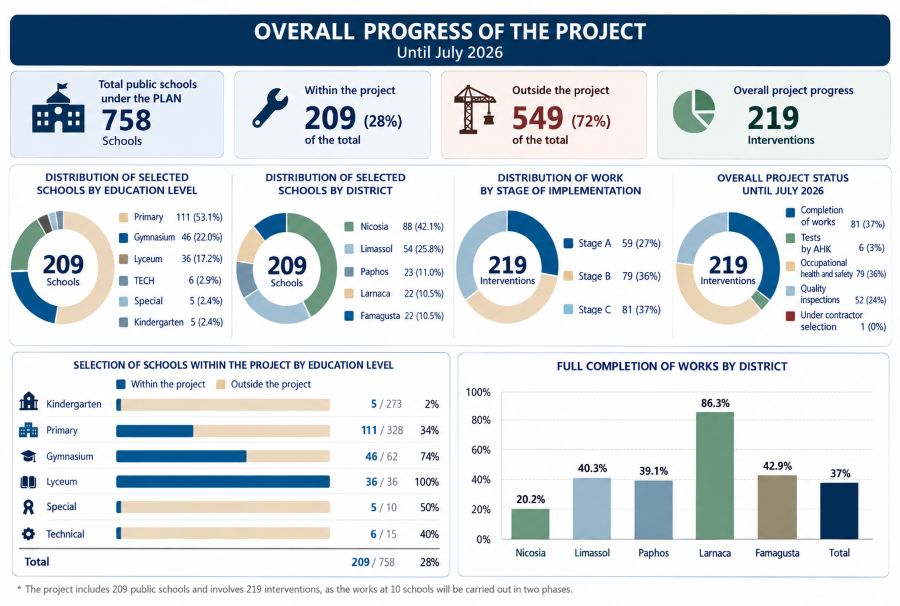
Work had been completed at 81 of the 219 cases involving public schools included in the project, representing 37% of the total. Although the project covers 209 schools, the number of cases stands at 219 because work at 10 schools will be carried out in two phases. Electrical work was still pending at 79 schools, while air-conditioning installation was underway at 52. Six schools were awaiting inspection by the Electricity Authority of Cyprus, while work had not yet begun at one school.
Progress also varied significantly among the School Boards. The highest completion rate was recorded by the Larnaca School Board, where work had been completed at 19 of 22 schools, or 86%. The Paralimni-Deryneia School Board followed, with work completed at 12 of 28 schools, or 43%. The Limassol School Board had completed work at 23 of 57 schools, or 40%, while the Paphos School Board had completed work at nine of 23 schools, or 39%. The Nicosia School Board had the lowest completion rate, with work completed at 18 of 89 schools, or 20%. The percentages alone do not fully reflect the work carried out by each School Board, since different numbers of schools were selected for each of the project's three phases.
The cost
Based on information provided by the School Boards to the Audit Office, the project's current cost stood at €9,819,430 plus VAT as of July 2026. The information provided also showed that estimated spending had been exceeded in several tenders, in some cases by significant amounts. However, the Audit Office said it could not quantify the total overspending because the information submitted by the School Boards differed in format, content and reference date.
Problems with implementation
The Audit Office found significant weaknesses in the project's planning and coordination, particularly during its early stages. Implementation was assigned in 2024 to the Nicosia, Limassol, Larnaca, Paphos and Paralimni-Deryneia School Boards despite their limited technical staffing. Giving the boards additional responsibilities for such a large project increased their workload, without evidence that they had sufficient capacity to handle the work effectively. At the same time, the Education Ministry's central coordination role was limited, particularly during the project's early stages. The Audit Office pointed to the fact that the Education Ministry appointed a central coordinator in April 2026, when the project had already reached its third and final phase.
The findings also showed that the project was not accompanied by a detailed budget for each phase. Without a detailed budget, the authorities had less ability to identify deviations early, assess whether spending was cost-effective and forecast the project's final cost.


