

Press Release
The latest Q1 2026 data confirm that Cyprus' construction sector continues to demonstrate remarkable resilience, supported by a strong investment pipeline, expanding construction activity and healthy business confidence. Building permits, production and lending indicators all remain consistent with sustained sectoral growth. Nevertheless, the latest building permit statistics relate to the pre-conflict period (January–March 2026) and therefore do not yet capture the potential effects of the recent escalation of tensions in the Middle East. Future releases will be important in assessing whether developers' investment intentions remain equally strong.
The construction pipeline strengthened considerably during the first quarter. The number of building permits increased by 44% year-on-year to 2.276, while permitted dwellings rose by 58% to 5.403. At the same time, permitted floor area expanded by 40% to 1.0 million square metres, and the value of approved projects increased by 41% to €1.3 billion. These figures point not only to continued investment appetite but also to an increasing concentration in larger, higher-value developments. Mortgage lending increased by 19.5% year-on-year during the first five months of 2026, pointing to robust underlying housing demand and suggesting that residential construction activity will remain supported in the coming quarters.
|
Building Permits Key Indicators, January – March 2026 |
|||
|
44% # of Permits (YtD % Change) |
58% # of Dwellings (YtD % Change) |
40% Area in sqm (YtD % Change) |
42% Value in € (YtD % Change) |
|
2.276 # of Permits (YtD) |
5.403 # of Dwellings (YtD) |
1.0M Area in sqm (YtD) |
1.3B Value in € (YtD) |
Current activity also remains robust. National accounts data show that gross value added in the construction sector increased by 4.9% year-on-year in Q1 2026, up from 3.9% in the corresponding period of 2025, confirming that the strong project pipeline is continuing to translate into real economic activity. The construction production index increased to 120.7 in Q1 2026, extending the sector's upward trend, while output prices rose by 4.7% year-on-year to an index level of 129.5, indicating that pricing power has remained intact despite moderating growth in production volumes.
Property market transaction data continue to signal strong underlying demand despite heightened geopolitical uncertainty. Sales contracts reached 10,007 during the first half of 2026, an increase of 15% compared with the corresponding period of 2025, extending the strong momentum recorded in 2025 when transactions rose by 15% to 18,114. Demand remains broad based across both domestic and foreign buyers. Transactions by domestic residents increased by 10% year-on-year in the first half of 2026, while purchases by foreign buyers grew by a stronger 23%, reflecting Cyprus' continued attractiveness to international investors and homebuyers. Growth was particularly pronounced among EU nationals, whose purchases increased by 29%, while transactions by non-EU nationals rose by 20%. Notably, property sales have remained resilient despite the escalation of tensions in the Middle East, suggesting that regional uncertainty has not affected investment decisions or housing demand. The continued strength of foreign demand, suggests that Cyprus remains widely perceived as a safe and attractive destination for property investment.
While the sector remains on a solid footing, some challenges are evolving and intensifying. Labour shortages have become the dominant production constraint, with 38% of firms identifying labour availability as the main limiting factor—up sharply from 11% in 2022 and substantially above the levels reported in services and manufacturing. Businesses are also increasingly citing uncertainty as a production constraint, with responses gradually increasing as happened during the COVID-19 period, while construction price expectations have risen noticeably in recent months.
Figure 1: Share of companies reporting labor shortages (19Q1-26Q2)
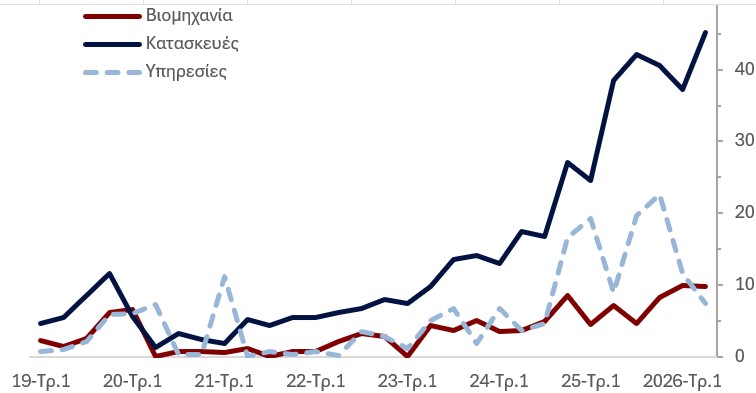
Overall, Cyprus' construction sector enters the second half of 2026 from a position of considerable strength, supported by a robust project pipeline, expanding activity and continued growth in construction value added. While labour shortages and heightened regional uncertainty have become more prominent challenges, current indicators suggest that the sector remains well placed to sustain its expansion.


