

Press Release
Cyprus tourism entered 2026 after a record 2025, when arrivals reached 4.53 million. Renewed instability in the Middle East then disrupted travel sentiment and reduced arrivals sharply in March and April. By July, however, the picture had improved: arrivals were only 1.1% below July 2025, following a 1.7% decline in June, compared with contractions of 30.7% in March and 27.6% in April.
Figure 1: Tourist arrivals recovered towards 2025 levels during June and July, following the sharp disruption recorded in March and April.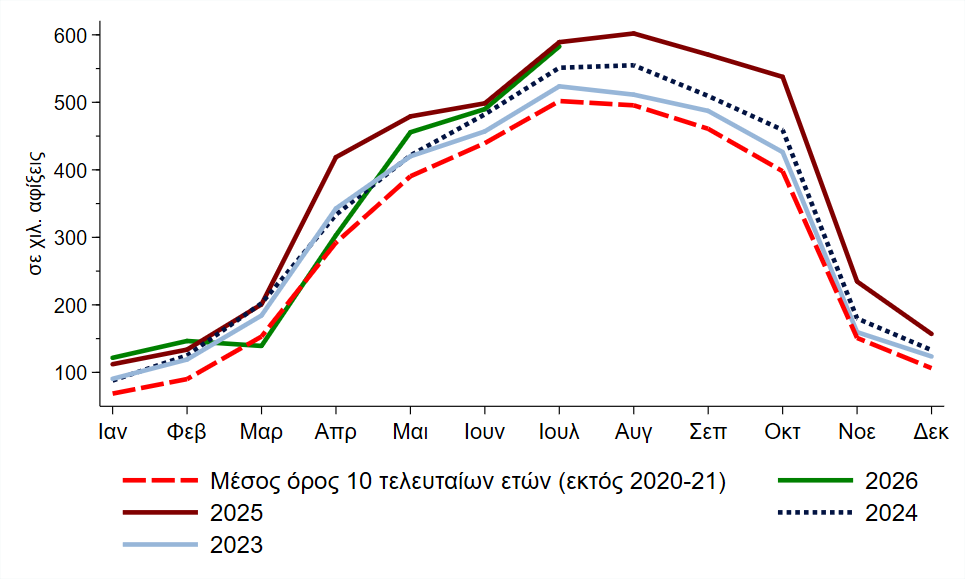
The rebound narrowed, but did not eliminate, the cumulative shortfall. January–July arrivals remained 8.0% lower year-on-year, equivalent to 193 thousand fewer visitors. Israel provided the clearest support, with arrivals increasing by 8.6% and adding 25 thousand visitors. By contrast, arrivals from the United Kingdom—the largest source market—fell by 11.1%, accounting for 90 thousand of the decline. Poland remained stable, while Germany, Greece and Scandinavia recorded more moderate reductions.
Figure 2: The recovery remains uneven: stronger arrivals from Israel partly offset the continuing shortfall from the UK, Cyprus’ largest source market.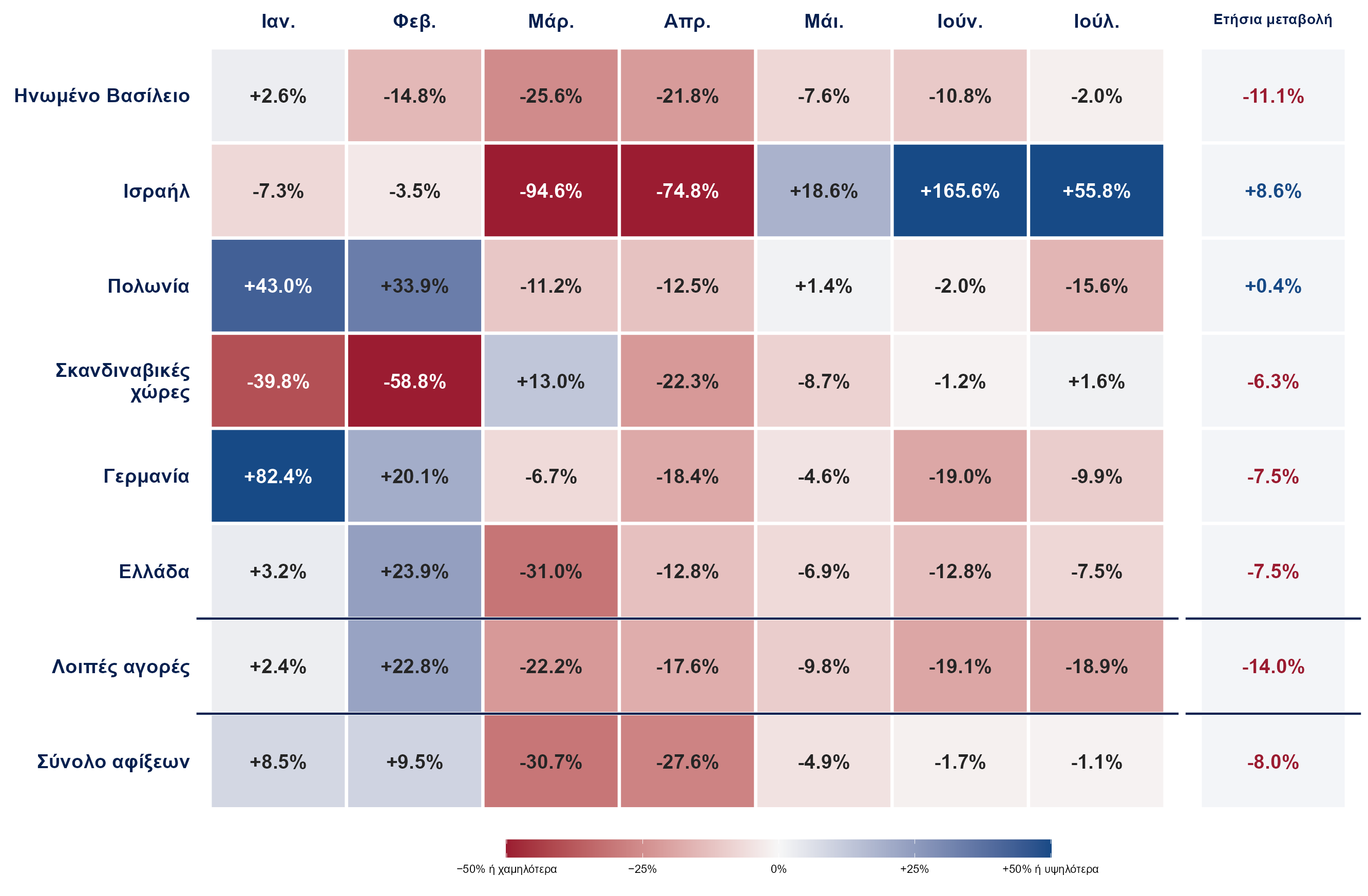
Note: Figures show the year-on-year change in tourist arrivals relative to the corresponding period of 2025. Scandinavia comprises Denmark, Sweden, Norway and Finland; “Other markets” includes all remaining source countries.
Source: CYSTAT; Eurobank Research calculations.
The underlying tourism infrastructure has remained intact. Airport passenger traffic declined by 3.7% during January–July, but commercial flights fell by only 0.9%, indicating that airlines preserved routes and frequencies. The adjustment has therefore reflected lower load factors and softer demand rather than a structural loss of connectivity. The recovery matters beyond hospitality: a stronger peak season supports aviation, transport, retail and food services, helping to contain the wider economic effects of regional instability. Nevertheless, uneven source-market performance demonstrates why expanding access to continental Europe and strengthening shoulder-season demand remain strategically important.
Based on the improvement observed through July, a continuation of the current trend—assuming arrivals during August–December remain around 1% below the corresponding 2025 levels—would result in approximately 4.32 million arrivals in 2026. This would represent a decline of 4.7% from the record 2025 level but would still leave arrivals 6.9% above 2024. A more cautious estimate, assuming that arrivals during the remaining months decline by 3.3%, in line with the average annual contraction recorded in May and June, would place total arrivals at around 4.27 million, 5.8% below 2025 but 5.7% above 2024. Both estimates therefore point to normalisation from an exceptional peak rather than a structural deterioration in tourism demand. The outlook remains cautiously positive, although performance continues to depend on regional stability, travel guidance and visitor confidence.


