

Newsroom
While much of the world's conversation around artificial intelligence focuses on whether AI will replace jobs, a group of Cypriot students is preparing to show how the technology can be used to solve some of tomorrow's biggest challenges.
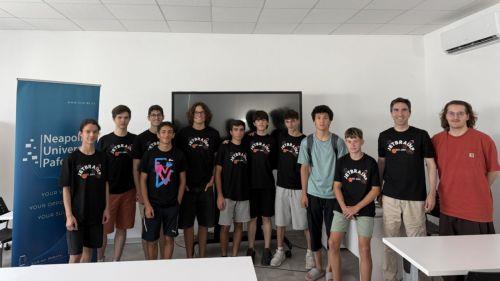
Cyprus will be represented by two national teams at the 3rd International Olympiad in Artificial Intelligence (IOAI), which takes place in Astana, Kazakhstan, from August 2 to 8. The competition is expected to bring together more than 400 students from over 100 countries, making it one of the fastest-growing international science competitions for high school students.
The Olympiad isn't about building chatbots or asking AI to write essays.
Instead, competitors tackle demanding real-world challenges in machine learning, data science, and artificial intelligence, testing not only their technical knowledge but also their ability to think critically, solve problems, and work with complex data. Each participating country can send up to two teams of four students, guided by team leaders.
For Cyprus, the competition is another sign that the island is investing in a generation growing up alongside AI rather than simply learning about it.
Earlier this year, students selected for the national teams took part in an intensive AI Winter Cyprus Camp at Neapolis University Pafos, where they trained in machine learning and competition-style problem solving ahead of the international event.
The timing couldn't be more significant.
Artificial intelligence is rapidly transforming industries ranging from healthcare and finance to education and transport, while governments and businesses around the world race to develop the skills needed for an AI-driven economy.
For the students representing Cyprus, however, the focus is much simpler: competing against some of the brightest young AI talent in the world and proving they can stand shoulder to shoulder with the best.
Whether medals come home or not, their participation highlights a growing reality for Cyprus: success in tomorrow's economy may depend just as much on developing AI talent as it once did on producing top mathematicians, engineers and scientists.


