

Newsroom
Why was the military destroying explosive ammunition in the middle of a scorching 40-degree summer day, despite rules banning exactly that?
That's the question many are asking after Monday's massive wildfire at the Kalo Chorio firing range in Larnaca, which forced evacuations, scorched about 120 hectares of land and exposed serious questions about military decision-making and Cyprus' emergency response.
Defense Minister Vassilis Palmas was livid and did not mince words.
The fire, which broke out at 12:40 p.m. inside the National Guard's Kalo Chorio shooting range, was brought under control just before 7:30 p.m. after an intense, hours-long firefighting operation involving more than 200 personnel, aircraft, helicopters, and dozens of emergency vehicles.
Defense Minister Vassilis Palmas was livid and did not mince words.
He said the fire started after the 70th Engineer Battalion destroyed six RPG projectiles at the firing range, despite standing rules that prohibit heavy weapons explosions during extreme heat.
"The 70th Engineer Battalion is responsible," Palmas said, describing the decision as "unprofessional" and promising a full investigation into why the operation went ahead under dangerous weather conditions.
"It will be investigated why they proceeded and how they proceeded to destroy these missiles," he said, adding that those responsible would face the full consequences allowed under military regulations.
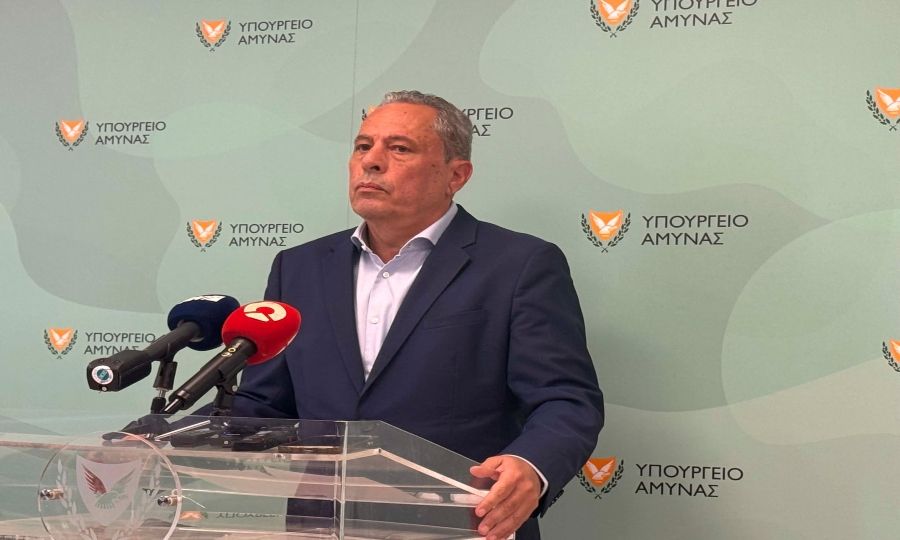
Palmas: I'll take political responsibility
While Palmas defended President Nikos Christodoulides from criticism, saying it was unreasonable to blame the president personally, he made clear he would not shy away from political accountability if warranted.
"If issues of political responsibility arise, then with all seriousness I will assume them," he said.
Why did CY Alert arrive nearly five hours later?
The military's actions were not the only issue drawing criticism.
Residents and local officials questioned why the government's CY Alert emergency notification wasn't sent until around 5:20 p.m., almost five hours after the fire began.
By then, the village of Agia Anna had already taken matters into its own hands.
Community leader Anastasis Georgiou said local authorities rang the church bell themselves to warn residents to evacuate because official alerts came far too late.
"The message came too late," Georgiou said. "We took the initiative ourselves."
He also claimed the problem wasn't new.
According to Georgiou, local communities had repeatedly warned authorities in previous years about military explosions taking place during periods of extreme heat, describing the practice as unacceptable.
"We had the same problems last year," he said, adding that similar concerns had again been raised this summer.
Wind turned fire into a race against time
Strong winds quickly pushed the blaze toward nearby communities, forcing the evacuation of Agia Anna while residents of Psevdas also received precautionary evacuation warnings. Church bells were also used there to alert residents to leave.
Fire Department spokesperson Andreas Kettis described the operation as extremely difficult due to high winds, rugged terrain and dense vegetation.
Protecting homes in Agia Anna and Psevdas became the top priority as firefighters battled rapidly changing conditions.
Authorities deployed six firefighting aircraft and five helicopters and activated the national Ikaros II emergency response plan. More than 100 Forestry Department personnel, 40 firefighters, Civil Defense volunteers, police, National Guard teams, ambulance crews, and local volunteers all joined the effort.
Firefighting crews remained at the scene overnight to deal with flare-ups and prevent the fire from reigniting.
Two people injured
Two people were injured during the emergency response.
According to Ambulance Service head Riana Constantinidou, a young volunteer fell from a height while trying to help extinguish the fire and suffered a leg injury. He was taken to Larnaca General Hospital.
Another person sustained minor injuries and was treated at the scene.
Bigger questions remain
Although the fire has now been brought under control, the focus is shifting from extinguishing flames to finding answers.
Investigators will examine why ammunition destruction was authorized during one of the hottest days of the summer despite safety restrictions, while officials are also likely to face questions over whether the delayed CY Alert notification left residents with less time to react as the wildfire spread rapidly toward nearby communities.
- Update: Residents cleared to return home after Kalo Chorio wildfire brought under control
- Firefighters gain ground but Kalo Chorio wildfire remains difficult to contain
- Another fire breaks out hours after Kalo Chorio blaze as crews rush to Mathiatis
- Wildfire breaks out after National Guard firing exercise in Larnaca (video)


