


Dorita Yiannakou
It is a blow to our country's tourism that more than half of the hotel accommodations on the island operate without a license. The issue of licensing Cyprus hotels, which is a long-standing problem, casts shadows over the legality and credibility of the Cypriot tourism product, as it poses risks related to the country's reputation and visitor safety, as the Audit Office points out in a report.
> > Read the report (in Greek) here < <
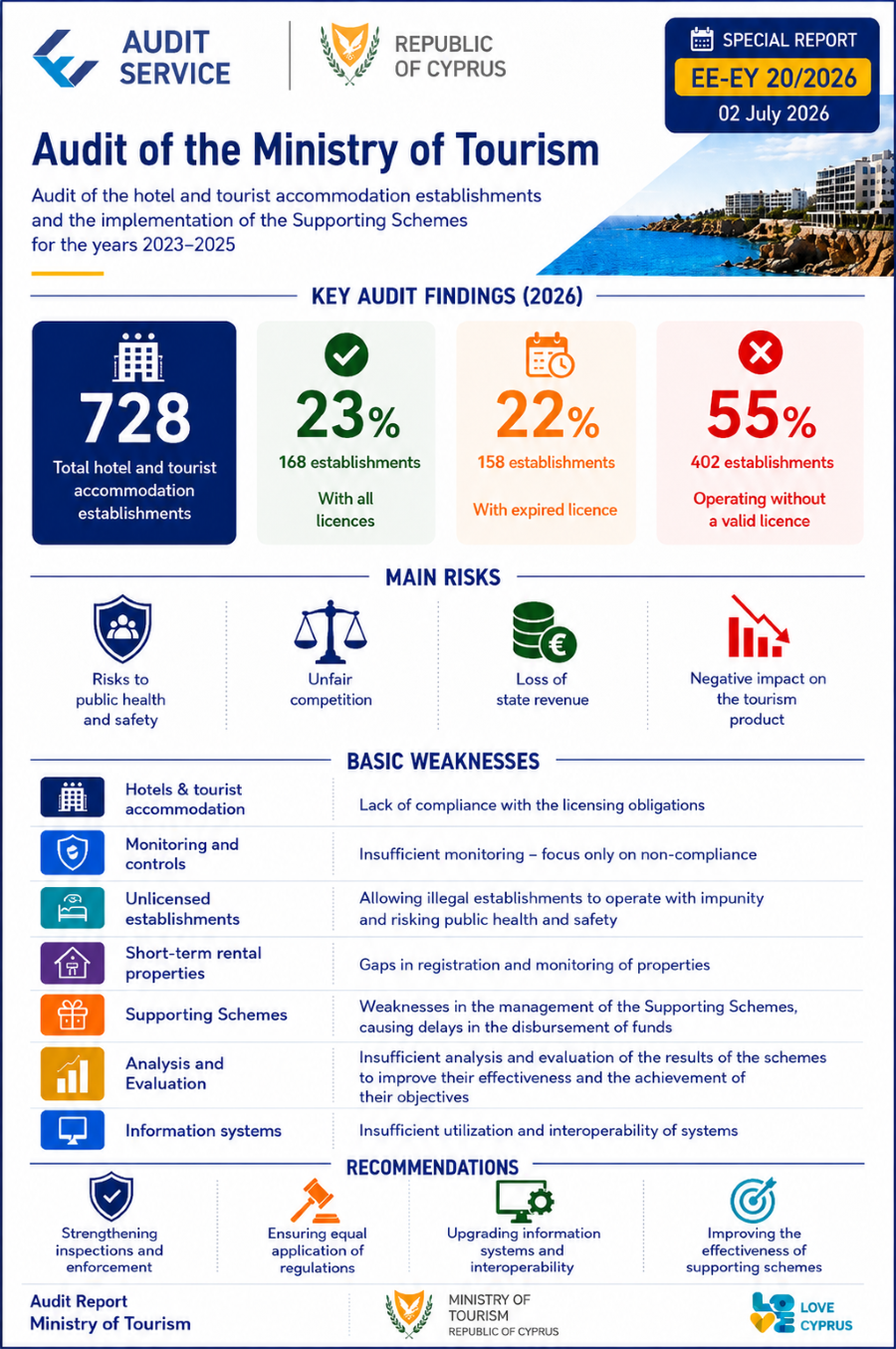
The Service identified serious weaknesses on the part of the Deputy Ministry of Tourism in bringing hotel entrepreneurs into compliance with the licensing regime, while also detecting distortions in the management of grant schemes and inefficient utilization of public resources. The Audit Office's special report on the control of hotel and tourist accommodation licensing and the management of grant schemes for the years 2023 through 2026 points out that the effort to upgrade the tourism product is called into question when only 23% of hotels and tourist accommodations are fully licensed. At the same time, the main findings of the report identify deficiencies in control mechanisms, limited utilization of information systems, insufficient interoperability, and weaknesses in internal control. The Audit Office report points out the need to enforce rules and operate reliable accountability and control mechanisms.
728 hotels in total, 402 without a license
It is striking that out of the 728 hotels and tourist accommodations registered with the Deputy Ministry as of April 27, 2026, only 168 (23%) have secured an operating license, while another 158 accommodations (22%) operate on the basis of a temporary operating license, provided they are unable to comply with the obligations for full licensing.
Essentially, 55% operate without full legality, with the highest percentage of unlicensed hotels found in the Famagusta district, which maintains 129 unlicensed hotels out of a total of 241.
The Deputy Ministry of Tourism is unable to implement control mechanisms, while weaknesses were also found in the design and monitoring of grant schemes
The non-enforcement of legislation creates a sense of tolerance, encourages non-compliance, and maintains conditions of unfair competition to the detriment of compliant businesses, emphasizes the Audit Office, noting that it sets a precedent for granting continuous extensions without any substantial result. In fact, the Audit Office attributes a stance of tolerance to the Deputy Ministry regarding the non-compliance of hotel businesses, pointing out that the imposition of sanctions and other compliance measures was almost non-existent. Invoking that strict application of the legislation might affect the tourism industry cannot justify inaction, underlines the Audit Office, noting that if the legislation is deemed inapplicable, proposals should be submitted for its revision.
Auditor General Andreas Papaconstantinou also emphasizes that it is unacceptable for provisions that are applied selectively to remain in force, as effective supervision requires clear actions on the part of the state in case of non-compliance, as well as a framework that rewards, rather than weakens, those who abide by the law. He also considers it a paradox that the state treats hotels in the same way, whether licensed or not, at a time when it recently announced measures to support employment in the hotel industry in which all hotels could participate, he states.
At the same time, the report also identifies distortions in the market for self-catering accommodations of the Airbnb type. More specifically, as noted in the report, 8,464 licensed self-catering accommodations on a pan-Cyprian basis were recorded in the Deputy Ministry's registry up to May 6 this year. However, as noted from the sample audit carried out on online booking platforms, there are indications that a significant number of self-catering accommodations operate and advertise without being registered in the Registry or with inaccurate licensing details, a fact that does not allow for their effective control and supervision.
Indicative is the finding that out of the twenty accommodations in the sample that could be identified, only six (30%) were registered in the Registry and held a valid registration license. Of the remainder, ten accommodations (50%) did not display a registration license number and did not appear to be registered in the Registry, while in four cases (20%), although a registration license number was displayed, it did not match the Registry data, as it either did not correspond to a valid registration number or concerned a different accommodation.
The risks
According to the special report, the current situation poses serious risks for Cypriot tourism, as it damages the reputation of the tourist product, creates conditions of unfair competition, deprives public revenue, endangers the safety and health of visitors, and weakens the credibility of the institutional and regulatory framework. The Audit Office attributes part of the problem to the highly complex licensing process, which requires the involvement of many state authorities and securing a series of approvals and certificates. Therefore, it suggests simplifying and accelerating licensing procedures through better coordination of competent bodies, without compromising visitor safety and health.
At the same time, it refers to the new transitional regime that allows units without an operating license, but with a building permit for tourist use, to continue operating under conditions until the end of 2028, expressing reservations about the effectiveness of the new regulation. According to the new regime, affected units operating with pending town planning or licensing issues, but possessing a building permit for tourist use, can continue to operate provided they secure an operating confirmation from the Deputy Ministry by the end of the year by submitting the prescribed certificates and supporting documents. This confirmation allows them to continue their operation initially until February 28, 2027, while, if the additional requirements of the Law are met, they can continue to operate under a transitional regime until the end of 2028, the date by which their full licensing must be completed. The extensions granted to date have not resolved the chronic town planning and licensing backlogs, and it remains uncertain whether the affected units will comply within the prescribed deadlines, argues the Audit Office.
The recommendations
The Audit Office suggests intensifying the efforts of the Deputy Ministry of Tourism, so that the licensing rate of hotel units increases significantly within the existing deadlines, without the need for new extensions of the legislation. At the same time, it proposes simplifying and accelerating the licensing process, particularly for older developments, strengthening controls and the imposition of sanctions on those who do not comply, as well as informing entrepreneurs and consumers about their rights and obligations, with the aim of ensuring legality, health, and safety in the tourism sector.
On the part of the Deputy Ministry, it is stated that it has already held a series of consultations with all competent state and institutional bodies, with the aim of definitively resolving the long-standing problem of licensing hotel businesses.
Grant schemes, indicators, and performance
At the same time, the report of the Audit Office identifies a series of serious weaknesses in the operation of the Deputy Ministry of Tourism, finding that clear and measurable goals are missing, as well as reliable performance indicators for evaluating the effectiveness of grant schemes. At the same time, deficiencies in strategic planning, weaknesses in state aid controls, and risks of double funding are recorded, while it is pointed out that exceptional approvals and deviations from the terms of the schemes may lead to unequal treatment of applicants. The report also refers to excessive bureaucracy, deficiencies in the transparency of procedures, and the evaluation of applications solely based on chronological priority, without taking into account social or developmental criteria. As demonstrated during 2025, the Deputy Ministry managed total expenditures amounting to €51.38 million, while the implementation of 13 incentive schemes is underway, four of which are funded by the Recovery and Resilience Plan (RRP) and the remaining nine from national resources.
The largest part of the expenditures, amounting to €20.69 million, was directed towards information and advertising campaigns in international tourism markets, as well as collaborations with tourism partners and airlines. At the same time, €10.40 million was allocated to grant schemes for the promotion of special forms of tourism, of which €8.1 million came from the RRP, while significant funds were also spent on staff payroll and other operational needs of the Deputy Ministry.
Furthermore, it is found that the absence of an integrated information system and the lack of interoperability between state services increase the administrative burden, cause delays, and reinforce the risk of errors.
Therefore, the Audit Office suggests establishing clear objectives and reliable performance indicators, strengthening control mechanisms and transparency, simplifying procedures, revising the criteria for evaluating applications so that developmental or social data are also taken into account, as well as developing an integrated information system with interconnection of the involved public services.


