

Newsroom
Borrowing money was once so cheap that some European governments paid no interest at all. Now those debts are coming due, and replacing them will cost considerably more.
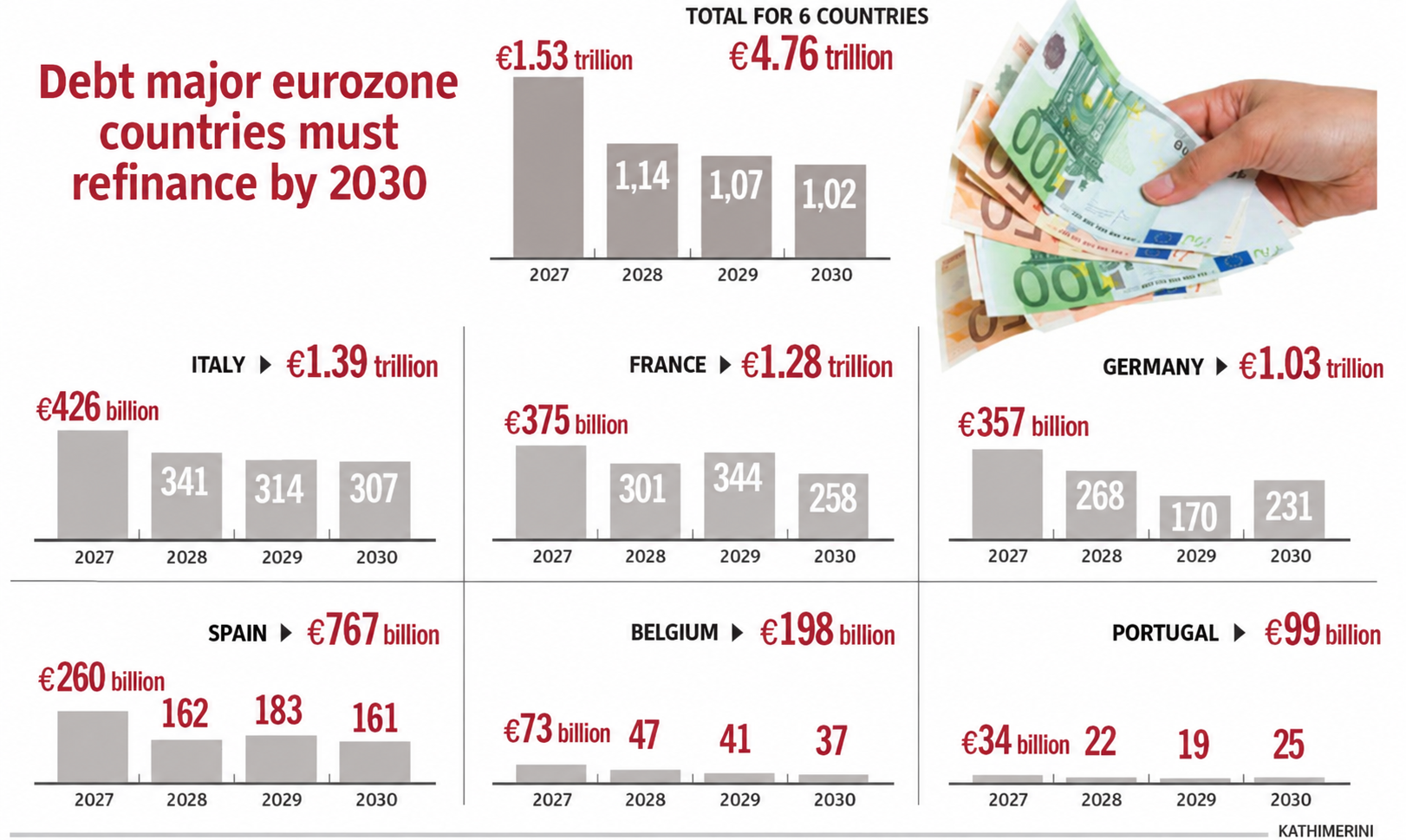
France, Germany, Italy, Spain, Portugal, and Belgium must refinance about €4.8 trillion in debt by 2030, according to figures compiled by Kathimerini.
That means issuing new bonds to repay old ones—a routine part of government financing. The problem is the price: much of the debt was issued before 2022, when interest rates were exceptionally low. Today, borrowing costs for some of Europe’s biggest economies range from around 3.5% to nearly 5%.
For a household, the comparison would be reaching the end of a cheap fixed-rate loan and discovering that the replacement comes with a much larger interest bill. For governments, the sums run into billions.
Italy faces the largest refinancing requirement among the six, at about €1.39 trillion, followed by France at roughly €1.3 trillion and Germany at around €1.1 trillion. Spain must replace about €770 billion, Belgium €200 billion, and Portugal €100 billion.
France illustrates how sharply the terms have changed. A 10-year bond issued in 2020 and due in 2030 carried a zero interest rate. Kathimerini reports that the yield on French 10-year bonds now exceeds 4.7%.
The change will gradually feed through to national budgets as older bonds mature. More money spent on interest leaves less room for services, investment, or help with household bills—unless governments raise revenue or borrow more.
The European Central Bank has also warned that higher borrowing needs and rising interest costs are squeezing governments’ room to respond to economic pressures. It says financial market strains could spread to the borrowing costs of banks and businesses.
Where does Cyprus fit?
Cyprus is not among the six countries covered by these figures. But sharing a currency and financial markets means it cannot ignore pressure building elsewhere in the eurozone.
If investors demand higher returns to lend to European governments, that pressure could also affect the cost of new borrowing here. Banks and businesses could face more expensive funding, although that would not automatically translate into an increase in every household’s mortgage payment.
The immediate issue is not that Europe must find €4.8 trillion overnight. These debts mature over several years, and refinancing is normal. What has changed is that the cheap borrowing of the past is being replaced by debt with a much heavier annual bill.
*With information from Kathimerini.gr


