


Dorita Yiannakou
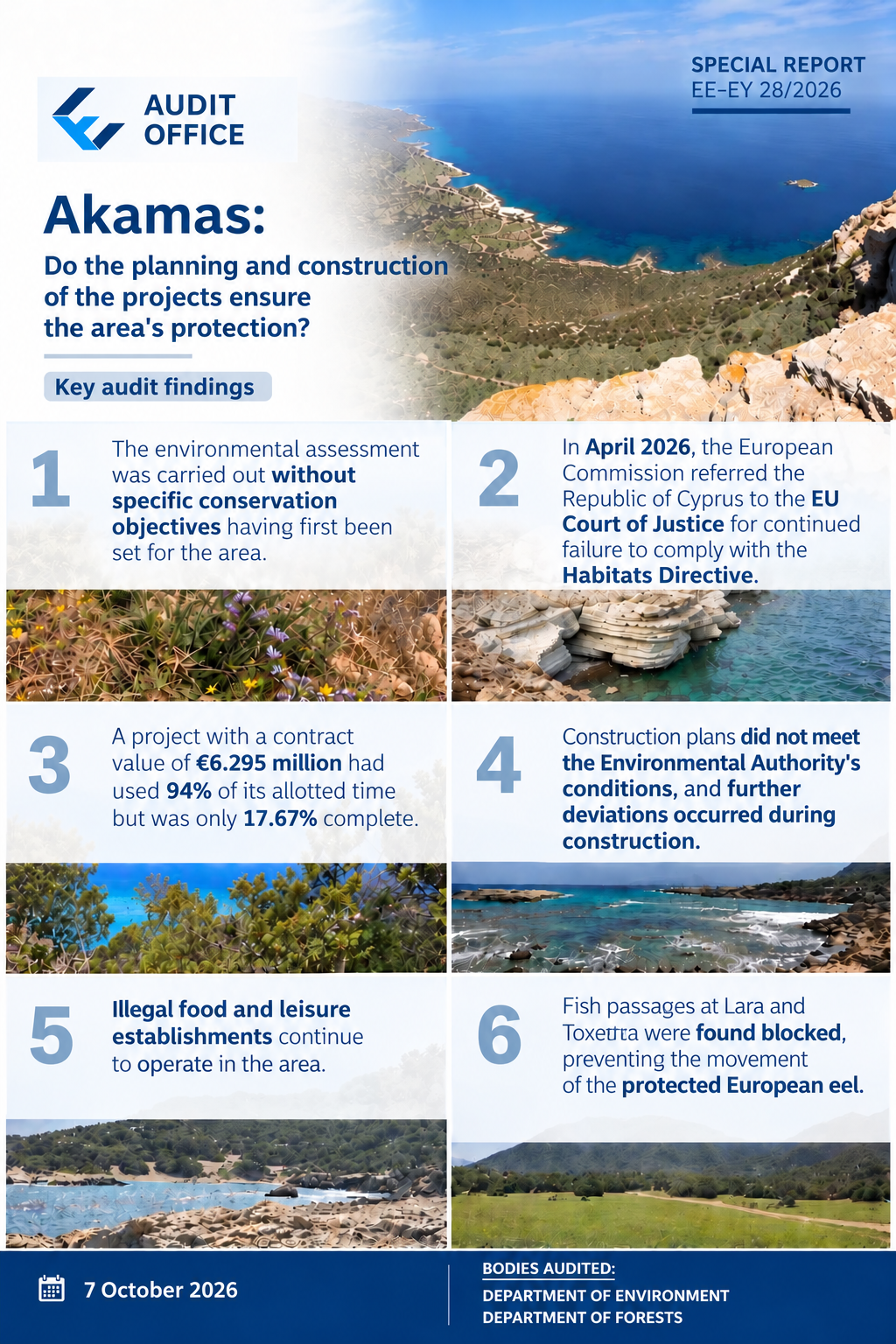
The Audit Office has identified serious gaps in the environmental safeguards for construction projects in Akamas, highlighting weaknesses stretching from the initial planning and environmental assessment to construction, supervision, and the handling of violations. In special report EE–EY 28/2026, the auditor general effectively documents the failure of the responsible authorities—specifically the Environment Department and the Forestry Department—to ensure that environmental requirements were incorporated into the plans and checked before construction began. As a result, departures from those requirements were identified only after the work had already been carried out.
Particularly striking is the report’s finding that safeguards intended to prevent problems did not stop these departures in all cases, making corrective work, redesigns, and additional environmental conditions necessary after construction had begun. In total, 19 additional or revised environmental conditions were imposed after work started. At the time of the audit, 17 had not been fully met.
The findings reveal gaps throughout the environmental protection process: assessing the impact, setting clear conditions, incorporating them into construction plans, checking compliance before work begins, and maintaining supervision throughout construction. The report also identifies problems involving excavation and excessive digging, water-management infrastructure, rainwater runoff and erosion, waste management, illegal roads and access routes, and unauthorized developments and activities within the protected area.
The Audit Office’s investigation revealed a series of significant weaknesses in environmental planning, permitting, the incorporation of environmental conditions into construction plans, monitoring of the work, and the handling of breaches and illegal activities within Akamas Park.
Findings and recommendations
The report identifies weaknesses dating back to the environmental assessment stage. Specifically, no screening report was prepared to determine whether Phase A of the project required a special ecological assessment.
It also raises concerns about how complete and adequate the environmental assessment was, particularly regarding specific conservation objectives and the assessment of impacts on protected features of the area. The report stresses that environmental assessment should serve as a meaningful preventive safeguard, rather than a process completed or corrected after construction begins.
Regarding the environmental conditions imposed, the Audit Office found that they were not always sufficiently specific or measurable in terms of the projects’ technical requirements. Particular problems were identified with roadside drainage channels, retaining walls, excavations, road cross-sections, water-management infrastructure, and bridge and culvert crossings.
The lack of sufficiently detailed conditions left room for different interpretations during design and construction, making it harder to check compliance effectively.
One of the Audit Office’s most significant findings concerns the failure to fully incorporate environmental requirements into the final construction plans. As a result, commitments made during the environmental permitting process were not fully reflected in the project’s technical design.
Specifically, the Audit Office found that the Forestry Department had not informed the project designer of all the legally binding environmental conditions contained in the Strategic Environmental Assessment opinion, which should have been taken into account when preparing the final construction plans.
The audit also identified discrepancies between environmental requirements and the design of bridge and culvert crossings. The Water Development Department said that, provided there were no serious technical or environmental constraints, the crossings should be redesigned to meet the environmental conditions.
The report also noted that the Environment Department had not sent the construction plans to the Water Development Department so it could confirm, before they were finalized and approved, that the relevant environmental conditions had been correctly incorporated.
A comparison of the environmental conditions with the standard cross-sections included in the construction plans also revealed discrepancies. This finding shows that requirements set during environmental permitting were not always accurately carried through into the project’s technical design.
During site visits, the Audit Office also found departures from the excavation plans. At one point along the Aspros Potamos–Lara road, for example, the excavation depth measured 2.10 meters, compared with a maximum of 1.875 meters specified in the construction plans.
Particularly significant is the finding that no further action was expected on two conditions relating to excessive excavation because the resulting environmental damage could no longer be reversed.
The report also links departures from the construction plans to the need to safeguard public money. As the authority responsible for the project, the Forestry Department should monitor progress against the contractor’s agreement when making payments and know the cost of each individual part of the construction work while ensuring that no overpayments are made.
The Audit Office therefore recommends investigating whether the contractor’s charges include additional costs arising from excavation beyond the specified limits. Where payments are found to have been made without justification, their recovery should be considered.
Significant problems were also identified with rainwater runoff and erosion of the road network.
Specifically, the failure to install a drainage network along the road allowed rainwater to flow into the park near Aspros Potamos, causing erosion along the roads under construction. Among other questions, the Audit Office asked why a hydrological and hydraulic study had not been carried out before construction began.
The report also highlights significant weaknesses in the management of excavation, construction, and demolition waste. It examined whether waste had been handled in accordance with environmental legislation and the relevant environmental conditions and whether designated, licensed disposal sites were available. One issue identified was that the waste management plan did not specify the licensed disposal sites clearly enough.
The audit also examined complaints and cases involving unauthorized developments and activities in the area. The report highlights the need for immediate action against illegal restaurants, food outlets, leisure establishments, and other activities, describing the cumulative environmental pressure on the area as particularly concerning.
In one case, the audit recorded a mobile canteen operating with awnings installed under a street-vending permit issued by Akamas Municipality. This underlines the need for coordination among the responsible authorities and for assurances that administrative permits do not allow activities incompatible with the area’s protected status.
Weaknesses throughout the environmental oversight process
The overall picture emerging from the Audit Office’s findings is that the different stages of environmental oversight did not function as a single, effective system for preventing problems. Environmental requirements set during assessment and permitting were not always clearly and fully incorporated into the technical design. Nor were compliance checks always adequate before work began.
In essence, there was a gap between environmental assessment, design, and construction. Conditions and requirements that should have been incorporated into construction plans from the outset were either not fully included or were not followed during implementation.
Responsibilities of the departments audited
The Audit Office’s report shows that the central issue concerns how the two departments under investigation exercised their roles and responsibilities.
Specifically, the Environment Department failed to ensure that environmental requirements were clear, workable, and fully incorporated into the design. The Forestry Department, as the authority responsible for the project, proved inadequate in communicating those commitments to the designer and contractor and ensuring they were followed during construction.
The Audit Office’s findings show that this chain of responsibility broke down at critical stages. As a result, environmental protection remained, to a significant extent, a matter of conditions and paperwork, without equally effective measures to ensure those requirements were applied on the ground.


