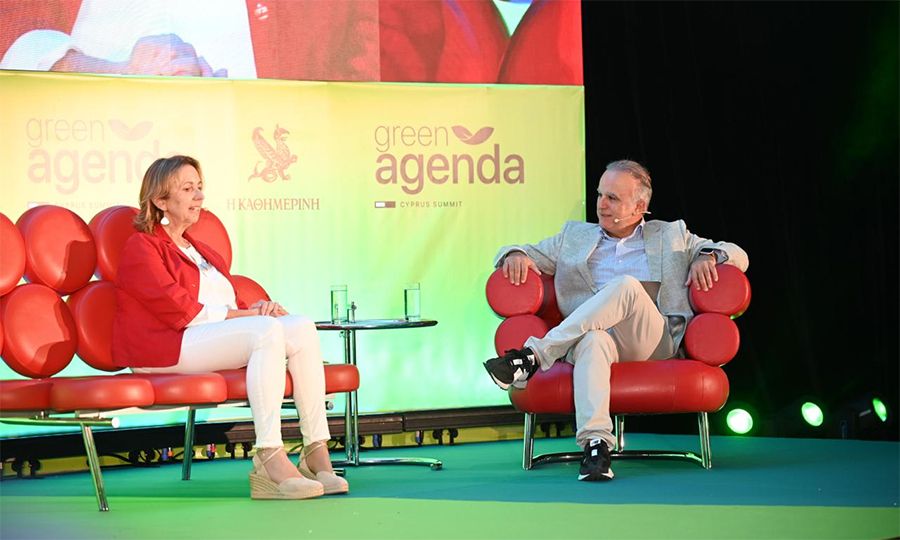
Rafaela Dimitriadi
Akamas is its villages, Environment Commissioner Antonia Theodosiou said during a discussion titled “Akamas… The Art of Doing Nothing” at the Green Agenda 2026 conference held in Nicosia on Thursday.
The discussion also featured SPP Media CEO and Green Agenda founder Demetris Lottides.
Akamas is its villages, says Environment Commissioner during Green Agenda 2026 discussion
Theodosiou stressed that for local residents, Akamas is essentially “half of the state forest towards Agios Kononas and beyond,” adding that this local understanding is important because many people from Nicosia often do not clearly know where Akamas begins or ends.
She explained that the Akamas Peninsula was later defined administratively and includes areas such as Pegeia, Kathikas, Pano and Kato Arodes, Ineia, Drouseia, Fasli, Androlikou, and Neo Chorio. In total, she said, the region covers around 22,000 hectares, with about 45% included in the EU Natura 2000 network.
Lottides described Akamas as a “hot issue” that has now become a national debate. When asked why Akamas is so important, Theodosiou said it ranks second in Cyprus—after Troodos—in terms of species richness; habitats; flora and fauna, both terrestrial and marine; as well as birdlife.
She noted that the area hosts species listed under European directives, which is why it was designated as a Natura 2000 site, while also supporting species of local ecological importance.
Half-finished road to Lara
During the discussion, Lottides presented a photo of the unfinished road leading to Lara, noting that works have remained incomplete for three years. He said construction stopped after concerns that the road was being built too wide and criticized the existing tracks in the area as being more suitable for off-road vehicles than proper infrastructure, questioning what is happening with Akamas development projects overall.
Theodosiou responded that the area stretching from the rocky zone to the beach contains what she described as “landmarks of substance.” She said roads will eventually be built, noting that a master plan had been prepared by consultants appointed by the Forestry Department.
However, she expressed disagreement with the current road design, adding that she was not responsible for the suspension of works. According to her, the works were halted due to “unnecessary excavations, excessive road widths, and unnecessary construction interventions.”
“The design is not progressing”
Theodosiou said repeated studies have been carried out. An ad hoc committee concluded that the proposed road layout—particularly drainage works—was incompatible with the area and required redesign.
She said the project has already been assigned twice and is now under a third review process by experts to determine whether the roads are appropriate or whether alternative solutions should be considered.
Wildlife and biodiversity
Turning to wildlife, Theodosiou highlighted the importance of turtle species in the region, noting that two significant species visit Cyprus. She said the green turtle breeds only in Cyprus and Turkey.
She also referred to the presence of the loggerhead turtle (caretta-caretta) and monk seals, saying these had been “largely overlooked for many years.” She added that monk seals have returned and now number around 20 individuals living permanently in the area, which she described as a sign of healthy marine ecosystems.
Thematic centres across Akamas
Theodosiou also outlined a series of thematic environmental and cultural centers developed across Akamas communities:
- Kathikas: Centre for terrestrial flora and fauna, along with plans for an environmental guesthouse.
- Pano Arodes: Centre for geology and palaeontology, as well as an amateur astronomy park.
- Ineia: Turtle conservation center.
- Androlikou: Beautification works carried out; the planned gorge center did not proceed.
- Neo Chorio: Reptile park established.
- Fasli: Planned open eco-museum, though administrative disputes between nearby communities have delayed progress.
Stone-built shelters and local development gaps
The discussion also touched on traditional rural stone shelters (stiaadia), many of which are now in ruins. Theodosiou said they should retain their dry-stone character, noting that they support biodiversity and have a role in the local microclimate.
She said restoration proposals had been made, including potential new uses, but the program did not move forward.
Theodosiou also highlighted a broader lack of coordination between local communities and the central government. She said proposals during her tenure included 23 thematic development areas, including the creation of a community-owned company that could help manage projects worth around €30 million.
She concluded that, had these plans been implemented, “Akamas today would be shining,” as she put it.