


Thanasis Photiou
The US-China rivalry, warnings about Europe falling behind, and the possibility of a major war took center stage in remarks by Nina Schick and Max Nikias, as well as the discussion at Digital Agenda Cyprus 2026.
Could artificial intelligence trigger a new conflict between superpowers? And what role can a small country like Cyprus play in a world where technological power is becoming a decisive factor in economic growth, national security, and geopolitical dominance?
These questions emerged from remarks by Nina Schick and distinguished academic C. L. Max Nikias, as well as the discussion that followed at Digital Agenda Cyprus 2026 in Nicosia.
Nina Schick described the rivalry between the United States and China as the technological competition that will define the 21st century. She argued that only these two superpowers have what it takes to achieve full strategic autonomy in artificial intelligence, with control over the entire production chain, from energy and raw materials to semiconductors and advanced computing systems.
 Nina Schick described the rivalry between the United States and China as the technological competition that will define the 21st century.
According to her analysis, the US leads in computing power and the development of advanced models, while China holds an enormous advantage in industrial manufacturing. She described the West's decision to shift a significant share of its production to China as a "huge strategic mistake."
She was particularly critical of the European Union, arguing that it had focused on regulating artificial intelligence rather than developing innovation and infrastructure. In her view, Europe must align itself strategically with the United States.
The "Thucydides trap"
The possibility that the technological rivalry could escalate into military conflict was discussed in the context of the "Thucydides trap," a theory that suggests the rise of a new power can trigger a clash with the dominant power.
Harris Georgiades pointed out that shifts in the global balance of power do not make war inevitable, but they do require political foresight and strong deterrence. He warned against taking peace for granted and called on democracies to strengthen their ability to defend their freedom and sovereignty.
Max Nikias challenged the application of this historical analogy to current US-China relations, emphasizing that nuclear deterrence and open lines of communication can help prevent a catastrophic conflict.
Our future and little Cyprus
Beyond the geopolitical rivalry, the discussion explored the profound changes artificial intelligence could bring to everyday life.
Schick described a future in which intelligence is produced on an industrial scale and supplied to the economy much like electricity. Nikias presented a vision of humans and machines living in harmony, predicting that robots will become a common part of our daily lives by 2030.
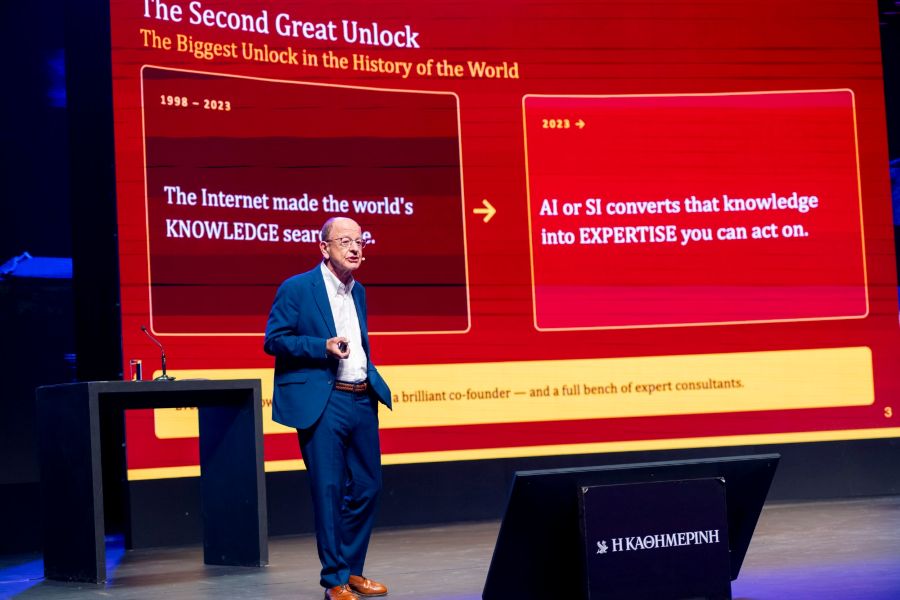
For Cyprus, Nikias pointed to the advantages of its geographical location and EU membership, noting that the country has the potential to attract international technology companies. However, he stressed that solving the energy problem is essential. He proposed deploying two small modular nuclear reactors (SMRs), which, in his view, could provide the additional power needed to develop data centers.
Schick stressed that smaller countries do not need to compete with superpowers on every front. Instead, they should identify the sectors in which they can build strategic value.
Cyprus's challenge, as discussed at the event, is to avoid becoming a bystander to a revolution that will determine not only who dominates tomorrow's world, but also how we live in it.


