

Newsroom
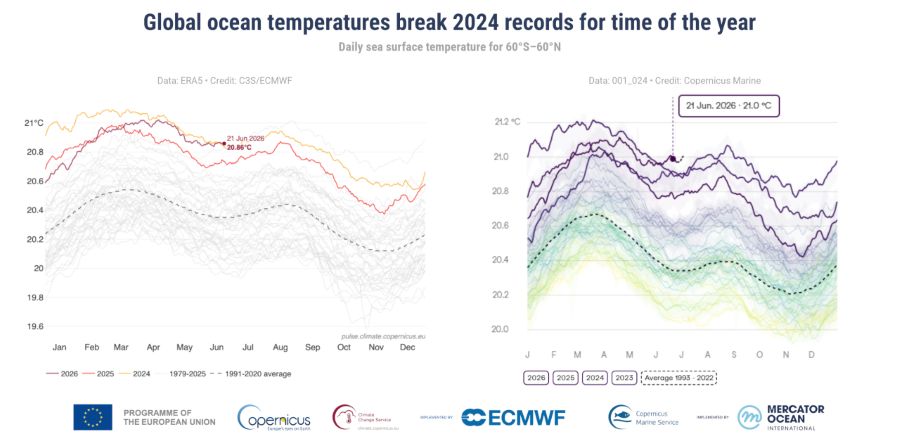
Global sea surface temperatures have officially broken all historical records for this time of year, signaling what scientists warn is a shift into "uncharted territory" for the planet’s climate system.
The alarming trend was jointly confirmed by two independent European scientific agencies, the Copernicus Climate Change Service (C3S) and the Copernicus Marine Service (CMEMS). According to their data, daily global sea surface temperatures broke previous records on June 21, hitting an average baseline between 20.86°C and 21.0°C depending on the measurement system used.
This is not an isolated spike. Over the past three years, the world’s oceans (excluding the polar regions) have consistently run between 0.35°C and 0.73°C warmer than the long-term historical average.
Climate scientists attribute this unprecedented surge to a combination of two powerful forces. The first is long-term, human-caused climate change, which continues to raise baseline temperatures globally. The second is the sudden arrival of a new El Niño event in the Pacific Ocean, recently announced by the World Meteorological Organization (WMO).
El Niño is a natural climate pattern characterized by the warming of surface waters in the eastern Pacific, which releases immense amounts of heat into the atmosphere. Climate models suggest that this specific El Niño could be one of the strongest witnessed in decades.
Experts note a worrying difference between current conditions and the record-shattering warmth of 2024. When ocean temperatures peaked in June 2024, the previous El Niño cycle was actually ending and beginning to cool. Right now, a brand-new, potentially massive El Niño is only just beginning. Because this heat engine is in its early stages, global temperatures are expected to keep climbing, likely breaking more records in the coming months.
A warming ocean has consequences that extend far beyond marine life, acting as a core driver for extreme weather across the globe. Scientists warn of several major ripples:
More extreme weather: Warmer ocean waters evaporate at a faster rate, pumping massive amounts of thermal energy and moisture into the atmosphere. This serves as high-octane fuel for more intense storms, hurricanes, and severe flooding events.
Marine heatwaves: Just like heatwaves on land, the oceans are experiencing prolonged periods of extreme, localized heat. These events disrupt marine ecosystems, cause widespread coral bleaching, threaten commercial fisheries, and impact coastal economies.
Rising sea levels: As water temperatures rise, the water physically expands, a process known as thermal expansion. Combined with accelerated melting of polar ice sheets, this is actively driving up global sea levels.
Hotter land temperatures: The oceans act as the planet's primary climate radiator. Because they are absorbing and holding such a massive volume of heat, they will keep the global atmosphere warmer for much longer, inevitably leading to higher temperature anomalies on land.
To verify the severity of the data, the two European services utilized entirely separate tracking tools. C3S monitored the situation via the Climate Pulse application, while CMEMS tracked data through the MyOceanHealth platform. Both services rely on a distinct mix of satellite observations and physical in-situ ocean buoys.
Because two completely separate monitoring systems using independent methodologies arrived at the exact same record-breaking conclusion, scientists express a exceptionally high level of confidence in the accuracy of the findings.
With information from the Copernicus Climate Change Service.


