


Shemaine Bushnell Kyriakides
Inside the Landmark Hotel last week, conversations about healthcare sounded less like policy debates and more like glimpses into the future.
Healthcare leaders, policymakers, doctors and industry experts gathered in Nicosia for the OEB Health Conference, “Transforming Healthcare in Cyprus: New Trends, New Realities,” a first-of-its-kind event that set out to answer a big question: What will medicine actually look like in the near future? Organized by the Cyprus Employers & Industrialists Federation (OEB), in cooperation with the Cyprus Medical Association and supported by the Ministry of Health, the conference brought together local decision-makers and international voices to explore how technology, innovation and new ideas are reshaping healthcare, and how the patient experience itself is about to change.
For decades, patients have largely depended on whatever information their doctor shared during an appointment. AI, she explained, is about to fundamentally change that relationship.
But beneath discussions about policy reform and healthcare economics, one topic quietly dominated nearly every conversation: artificial intelligence.
And according to one of the conference’s keynote voices, the transformation is no longer theoretical.
It has already begun.
From Hospitals to Algorithms
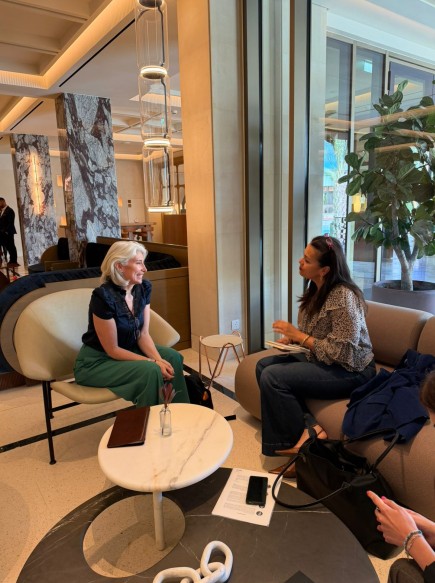
During the conference, I sat down with Sara Siegel, Deloitte’s Global Health & Human Services Sector Leader, whose work places her at the center of healthcare transformation across Europe and beyond.
With more than two decades advising healthcare systems, including extensive work with the UK’s National Health Service, Siegel has watched medical systems struggle with rising costs, staffing shortages, and growing patient expectations. For the past two years, she has also led Deloitte’s healthcare practice across North and South Europe, helping governments and providers navigate digital transformation.
Her message in Cyprus was clear: the biggest shift in medicine won’t be felt first by doctors or hospitals but by patients themselves.
“The most important change,” she said, “is how people will experience healthcare.”
For decades, patients have largely depended on whatever information their doctor shared during an appointment. AI, she explained, is about to fundamentally change that relationship.
Instead of being passive recipients of care, patients will increasingly become active participants, able to access reliable medical insights, understand treatment options, and interact with healthcare systems in ways that are clearer and more personalized.
In simple terms, healthcare will start speaking a language ordinary people understand.
When AI Gets It Right
Siegel illustrated the shift with a real-life example.
A colleague in the United States rushed his three-year-old daughter to an emergency room after she developed a sudden high fever and rash. While waiting for doctors, he entered her symptoms into a readily available consumer AI tool. The system suggested a rare bacterial infection affecting roughly one in 300,000 children.
After days of testing and consultations, doctors confirmed the exact same diagnosis.
Stories like this, she said, are becoming increasingly common, not because AI replaces doctors, but because it processes vast amounts of medical knowledge faster than any human could.
“One person’s lifetime of learning can’t match the collective knowledge AI can hold,” she said. “But it still needs the clinician’s judgment.”
For now, AI acts as a powerful assistant rather than a decision-maker, closer to an advanced diagnostic tool than a replacement for medical expertise.
Will AI Make Healthcare More Expensive?
Counterintuitively, Siegel believes the opposite will happen.
Healthcare systems today spend roughly 70% of their budgets on human labor. AI can reduce administrative burdens, shorten hospital stays, and help clinicians focus on complex cases instead of paperwork.
There is an upfront challenge: digitization. Countries that still rely heavily on paper records must first invest in structured data systems. But once that foundation exists, costs tend to fall while care becomes more consistent.
AI-driven clinical support could also reduce one of healthcare’s biggest hidden problems, variability.
Today, treatment outcomes can differ dramatically depending on which doctor a patient sees. AI tools can provide clinicians with global medical knowledge alongside their own experience, helping standardize care without removing human decision-making.
Are Doctors Ready?
Six months ago, Siegel said, many clinicians feared AI would replace them.
Now, attitudes are shifting quickly.
Doctors increasingly use voice transcription tools, automated documentation, and digital assistants, realizing AI functions more like a new medical instrument than a competitor.
What technology still cannot replicate, she emphasized, is empathy, intuition, and the ability to interpret subtle human signals.
“The human connection remains essential,” she said.
Cyprus’ Unexpected Advantage
For Cyprus, the conversation carries particular urgency.
Siegel believes smaller countries may actually have an edge in the coming healthcare revolution. With a population of just over one million, system-wide reforms can happen faster than in large bureaucratic systems like the UK’s NHS.
Cyprus, she noted, already has strong foundations: EU integration, internationally trained clinicians, and access to global knowledge networks.
The challenge now is mindset.
Rather than patching existing problems, she argues, countries like Cyprus have a rare opportunity to redesign healthcare from the ground up, integrating innovation early instead of retrofitting it later.
“Small countries have a huge opportunity right now,” she said. “The key is to be bold.”
Medicine Without Walls
If her predictions hold true, healthcare a decade from now will look almost unrecognizable.
Fewer hospital visits. More care delivered at home. Wearables, smartphones and everyday devices continuously monitoring health conditions. Simple eye scans capable of detecting early signs of diseases such as Alzheimer’s or cancer, technologies already emerging in parts of Europe.
Routine testing could move out of clinics and into households, turning prevention into the norm rather than the exception.
Hospitals, in this vision, become places for critical care, not the center of everyday medicine.
A Turning Point Conversation
The OEB Health Conference aimed to spark dialogue about policy and reform. But its deeper takeaway may have been something broader: healthcare is entering a transition as profound as the digital revolution that reshaped banking, media and communication.
AI is not arriving someday.
It is quietly rewriting medicine now, changing how doctors work, how systems operate, and most importantly, how patients understand their own health.
For Cyprus, the question is no longer whether that future will arrive.
It’s whether the country chooses to lead it...or catch up later.


