

Newsroom
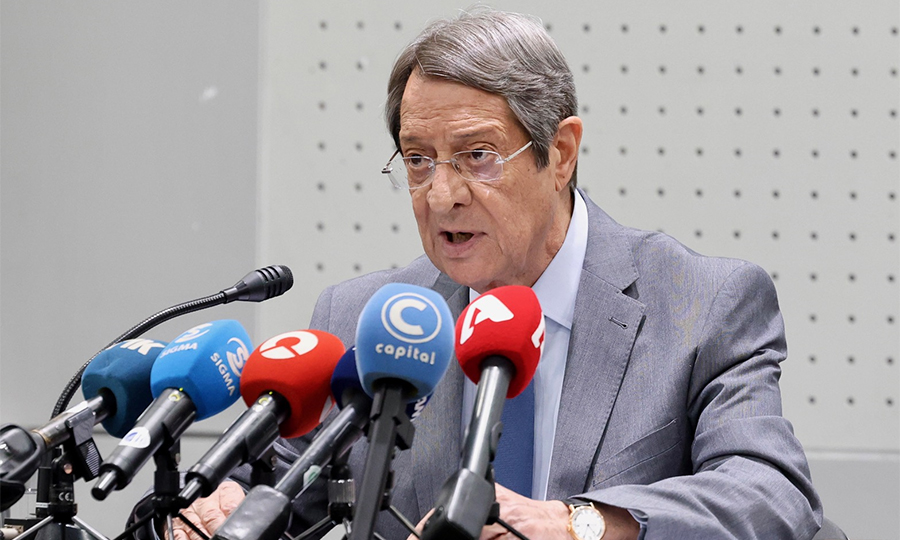
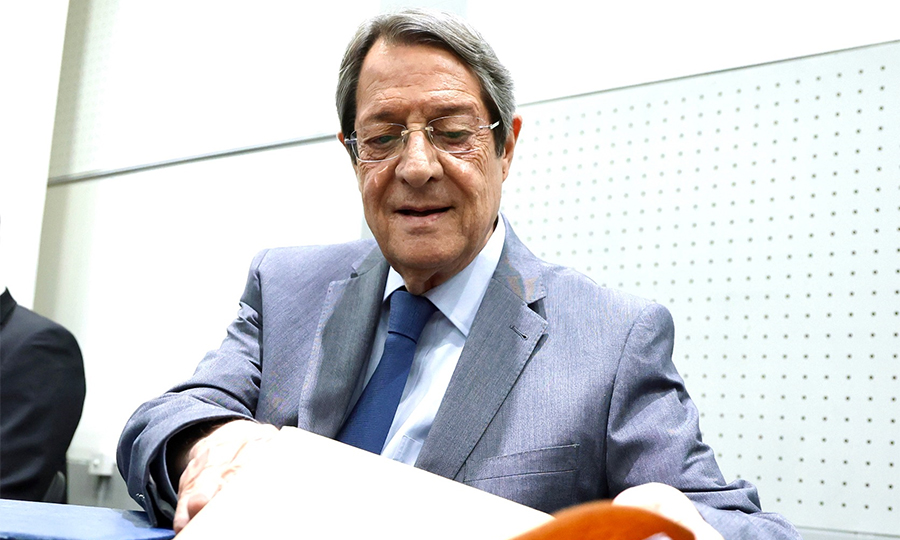
Former President Nicos Anastasiades strongly criticized the Independent Authority Against Corruption during a press conference where he responded to the findings of the Mafia State report.
Throughout his remarks, Anastasiades argued that the Authority reached several conclusions without giving him an opportunity to respond to the allegations or correct what he described as factual errors. He said it was unacceptable for his reputation to be damaged before his own account had been properly considered.
Referring to the public reaction that followed the publication of the report, Anastasiades spoke about what he described as a toxic climate marked by personal attacks, reputational damage, and the promotion of what he called the fictional narrative surrounding the Santi case.
"Defamatory Allegations"
Addressing what he referred to as "people's judges," Anastasiades said many critics ignored the fact that investigators and the Anti-Corruption Authority had rejected or declined to accept what he called defamatory allegations against him.
While insisting that he does not object to scrutiny, he called for the appointment of a criminal investigator so that, in his words, "the truth can come out."
Working through the report chapter by chapter, Anastasiades responded to the potential offenses identified by the Authority and sought to challenge the conclusions that may be attributed to him. In several instances, he spoke in a particularly forceful tone.
Discussing the arrest of Elena Rybolovleva, he dismissed allegations connected to an SMS message as fiction and argued that investigators incorrectly connected unrelated events, leading to flawed conclusions.
Turning to the chapter The Offshore President: The Truth About Focus, he rejected claims that he appropriated €500,000 intended to cover voter transportation costs and party expenses connected to DISY's campaign for the 2009 European Parliament elections.
Addressing the Abramov case, Anastasiades said that after an application involving Abramov's wife was rejected, the Council of Ministers under then-President Dimitris Christofias amended the relevant provisions to permit naturalization.
"I want to be fair," he said. "The economic crisis at the time required incentives to attract investment into the country."
In a sharp response, Anastasiades questioned whether anyone could seriously claim that an opposition member of parliament directed a government minister to carry out an illegal naturalization.
"Since when does the opposition exercise executive authority instead of the government?" he asked.
He also criticized the Anti-Corruption Authority for treating what he described as an absurd allegation as a serious matter.
Anastasiades went on to discuss social media, including TikTok, arguing that authorities should examine how online influencers contribute to the formation of negative public perceptions.
He also posed a broader question:
"Do we want a state governed by the rule of law or a state governed by the internet?"
His remarks included further references to the Santi case. He argued that action should be taken against individuals who, in his view, undermine institutions through fictional narratives, whether in Mafia State or in claims connected to the Santi affair.
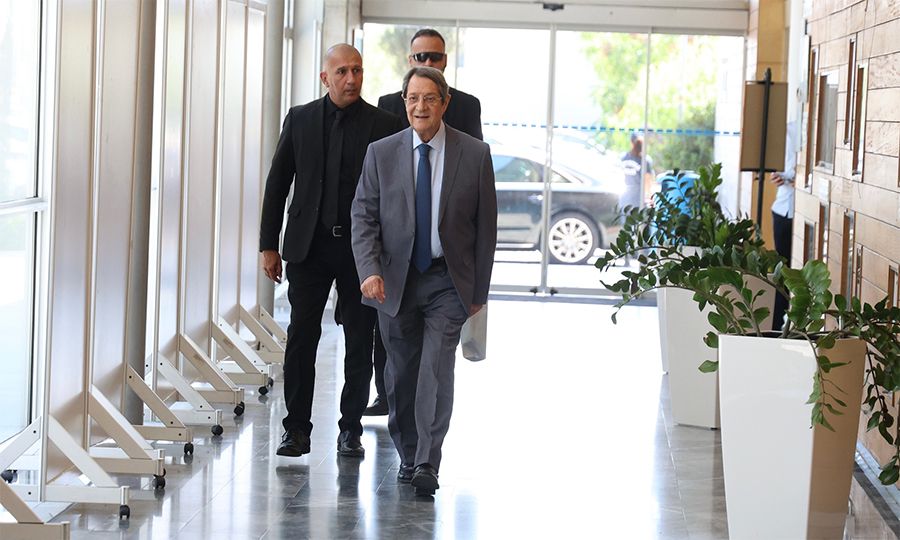
Statement by Nicos Anastasiades
Chapter 1: The Oligarch and His Fiefdom
Anastasiades argued that allegations surrounding the so-called "Rybolovlev Law" collapsed because the legislation received support from nearly the entire political and institutional establishment.
The measure passed Parliament with only two votes against it and was backed by the government, the Central Bank, the Association of Banks, the Cyprus Bar Association, ICPAC, the Cyprus Chamber of Commerce and Industry, STEP, the Attorney General, and other organizations consulted during the legislative process.
According to Anastasiades, the investigators reached the same conclusion.
Manipulation of Justice
Anastasiades noted that this section does not refer to any involvement on his part and said he therefore had no comment.
The Arrest of Rybolovleva
According to Anastasiades, the entire narrative centers on claims that he knew about or participated in the arrest of Rybolovlev's wife.
He argued that neither the book nor the Authority's report contains evidence of any direct or indirect action by him that would demonstrate knowledge of or involvement in the arrest.
He further argued that the allegations rely entirely on SMS messages which, according to the Authority itself, cannot be treated as reliable evidence without supporting proof.
The report acknowledges that some of the claims made by journalist Makarios Drousiotis depend almost entirely on those messages, which are the primary source used by both the author and investigators.
Anastasiades also pointed out that the narrative revolves around a single SMS in which an individual identified as "No. 1," assumed by some to be the former President, allegedly stated:
"I hope the Attorney General does not intervene."
How Incorrect Connections Produced Incorrect Findings
Anastasiades argued that investigators incorrectly connected Rybolovleva's arrest to another SMS discussing alleged arrangements by Andreas Hatzikyriakou for a one-way flight from Brussels to Athens.
According to Anastasiades, investigators then concluded that he may have committed the offense of trading in influence by accepting an improper benefit in exchange for influencing public officials.
The implication, he said, was that he intervened to facilitate Rybolovleva's arrest.
Page 28 of the report states:
"The Inspection Officers found, on the balance of probabilities, that there was an agreement between former President Nicos Anastasiades and Dmitry Rybolovlev under which Rybolovlev would cover the cost of a private flight for the former President from Brussels to Athens on March 21, 2014, and that Andreas Hatzikyriakou facilitated that arrangement."
According to Anastasiades, investigators and members of the Anti-Corruption Authority overlooked a key point.
In the subchapter The Oligarch Demands Explanations, the author of Mafia State writes on page 48 that:
"On March 6, 2014, an urgent meeting between Rybolovlev and Anastasiades was arranged in Dublin, Ireland, where the President was attending a conference of the European People's Party. During that meeting, a new plan of action was agreed upon, the details of which emerge from messages recovered from Bersenda's mobile phone."
On page 50 of the same book, the author writes:
"Among the financial benefits Anastasiades secured from this new cooperation was the oligarch's agreement to pay for his travel by private jet."
The author then adds:
"As a first step, a jet would be chartered for a one-way trip by Anastasiades."
On March 20 and 21, Anastasiades was attending a meeting of the European Council in Brussels. Hatzikyriakou informed Bersenda that the President wanted to travel from Brussels to Athens on March 21 and then return to Cyprus on a commercial flight.
Anastasiades points out that the alleged plan to arrest Elena Rybolovleva took place on February 24, 2014.
Based on that timeline, he argues that the Authority's conclusion regarding possible trading in influence cannot stand. According to his argument, the alleged benefit involving the private flight was not connected to Rybolovleva's arrest. Instead, even the book itself presents it as part of a separate plan that was supposedly agreed upon later.
Ladies and gentlemen, given that the Anti-Corruption Authority rejected many of the claims made throughout Mafia State as unsubstantiated and accepted the documented responses I presented in my book The Slanderer, I will focus on the findings where the Authority concluded, on the balance of probabilities, that I may have committed offenses requiring further investigation.
Chapter 2: The Offshore President, The Truth About Focus
According to the author's account, Focus Maritime was used as a channel through which Andreas Vgenopoulos financed political parties in Cyprus.
The claim is that Focus paid for the transportation of overseas voters during the 2008 presidential election, contributing €1.5 million to AKEL and €500,000 to DISY.
After those contributions became public in 2014 and generated significant public attention, the Attorney General ordered an investigation to determine whether any criminal offenses had been committed and who, if anyone, was responsible.
Once the investigation was completed, the Attorney General announced on January 27, 2016, that a review of the police file found no evidence of criminal wrongdoing. At the time, undeclared political party financing was not classified as a criminal offense.
Another allegation claims that Anastasiades personally appropriated a total of €550,000 intended for DISY, including funds for transporting voters during the 2008 election and campaign expenses related to the 2009 European Parliament elections.
According to Anastasiades, investigators rejected those allegations as false and unsupported by the evidence presented to the Anti-Corruption Authority.
Even so, the Inspection Officers concluded that there may have been a case of abuse of power.
Paragraph 73.21 states:
"This finding is based, among other things, on testimony that while the Focus Maritime investigation was underway, Mr. Anastasiades met and spoke by telephone with then Attorney General Kostas Clerides, expressing strong dissatisfaction with the course of the investigation and requesting that questioning be discontinued on the grounds that no criminal offenses had been identified."
Paragraph 73.22 states:
"The Inspection Officers concluded that this intervention may have amounted to improper executive pressure on the Legal Service, which is constitutionally independent, and that it could have affected the integrity of the investigation, the administration of justice, and the public interest."
The report goes on to conclude that these circumstances may indicate acts of corruption attributable to the former President and may amount to the felony offense of abuse of power.
It further states:
"There is testimony suggesting that there may have been a personal or political benefit in stopping an investigation that could have revealed possible involvement by the former President in securing funding for DISY, which could constitute the felony offense of abuse of power."
I view these findings with surprise, disappointment, and bitterness.
The first point I want to make is that this allegation was never put to me during my testimony before the Inspection Officers.
As a result, I was never given the opportunity to challenge the allegation or address the conclusions that ultimately appeared in the Authority's report.
In response to these findings, I would like to make the following observations.
(a)
Page 41 of the Authority's report states:
"The testimony that there may have been a personal or political benefit in stopping an investigation that could have revealed possible involvement by the former President in securing funding for DISY could constitute abuse of power amounting to a felony."
This conclusion directly contradicts the Authority's earlier findings, which stated that the former President did not personally receive a single cent from the contributions made to DISY.
Just as important, the Attorney General at the time concluded that no criminal offenses had been committed.
Therefore, what benefit did Anastasiades supposedly receive that would be necessary to establish the felony offense of abuse of power?
Why would he seek to stop a criminal investigation? Was it to prevent investigators from uncovering incriminating evidence related to a criminal offense that, according to the Attorney General's own findings, did not exist?
Allegation Against the Former President
According to the findings of the Inspection Officers, the evidence suggests that at the end of 2011 a €250,000 transaction was carried out by Laiki Bank for the benefit of Anastasiades. The money was allegedly intended to support his 2013 presidential campaign and was presented as a fee or commission rather than political funding.
The report further claims that the payment was agreed upon between Andreas Vgenopoulos and Anastasiades. According to that allegation, Anastasiades requested that the money be classified as a fee or commission by making use of Laiki Bank's practice of paying introducer fees.
Investigators also allege that two fictitious invoices, one for €160,000 and another for €90,000, were used to disguise the payment. According to the report, the funds were presented as introducer fees and routed through an offshore company in the British Virgin Islands to conceal both their true purpose and their ultimate beneficiary.
The report goes on to state that investigators found evidence linking Masterton International Corp. and Truro Investments Ltd. to the law firm Nicos Chr. Anastasiades & Partners and individuals associated with the firm.
The connection between Anastasiades and these allegations is described in paragraph 74.7, which states:
"While the former President and his partners at the law firm Nicos Chr. Anastasiades & Partners claimed that he was a silent partner, the private Partnership Agreement dated September 9, 2001 shows that he bears overall responsibility for supervising the operations of the partnership."
The report ultimately concludes:
"Mr. Nicos Anastasiades, while serving as a Member of Parliament and President of DISY, abused whatever influence he may have exercised over others involved in decision-making processes and, acting as a seller of influence, sought to disguise the nature of the transaction with Laiki Bank in order to conceal its true purpose and beneficiary."
It further states:
"By receiving the relevant sums, which constitute an improper advantage, Mr. Nicos Anastasiades may have committed the offense of passive trading in influence."
Passports and Jets
This section is divided into two parts.
The first concerns an article published on August 14, 2019 by the Organized Crime and Corruption Reporting Project (OCCRP) under the headline Bank Records Link President of Cyprus to Troika Laundromat.
The second concerns an article published on October 3, 2021 by the International Consortium of Investigative Journalists (ICIJ) following the publication of the Pandora Papers.
Before addressing the findings of the Inspection Officers regarding the OCCRP allegations, I would like to outline the facts as I understand them.
On August 14, 2019, OCCRP published an article claiming that the law firm Nicos Chr. Anastasiades & Partners had assisted Russian businessman Alexander Abramov in laundering hundreds of millions of dollars.
The article further alleged that companies connected to the law firm were deeply involved in the Troika Laundromat, a network of shell companies that operated between 2006 and 2013.
At the same time, The Guardian reported that:
"The scheme consisted of a network of 70 offshore shell companies used to move billions of dollars from Russia into Western countries."
Although the OCCRP article explicitly stated:
"None of the documents referenced in the publication provide evidence that the law firm or its associates violated any law or committed any offense,"
the opposition seized on the report and generated intense public criticism of the former President, portraying the publication as a scandal of enormous proportions.
Faced with what he describes as an unjustified and unacceptable situation, and unaware that MOKAS had already launched its own investigation, Anastasiades says he requested an official investigation to determine whether any offenses had occurred and, if so, who was responsible.
Findings of the Anti-Corruption Authority
After referring to the former President's public statement, the Authority reached what Anastasiades describes as an unacceptable conclusion:
"The use of the presidential office to influence a matter directly connected to personal interests, specifically through prompting action related to the MOKAS report under circumstances that significantly increased pressure on the competent authorities to act, creates serious questions about institutional interference, improper use of executive influence, and abuse of power."
The findings also contain strong criticism of Ms. Papakyriacou:
"As the country's central anti-money laundering unit, MOKAS had a duty to conduct its own investigation and secure evidence. Nevertheless, it relied on the explanations provided. Despite the existence of evidence that justified additional criminal investigation, MOKAS concluded that no criminal conduct had been identified."
According to Anastasiades, the most striking finding appears in paragraph 75.17:
"The Attorney General, who had final authority over whether to accept or reject the MOKAS report, agreed with its conclusions."
The Inspection Officers ultimately concluded that the nature of this action, namely the former President's public call for an investigation, could potentially establish criminal liability for abuse of power or attempted abuse of power.
Ladies and gentlemen, I consider it completely unacceptable that a request for an investigation into allegations of this nature could itself be treated as the possible commission, or attempted commission, of abuse of power.


