

Newsroom
The number of people in prisons across the European Union rose again in 2024, continuing a post-pandemic upward trend that has now reversed years of gradual decline.
According to new EU data, there were 508,746 prisoners across the bloc last year, a 2% increase compared with 2023. The figures show that after years of falling numbers, reaching a low point in 2020, Europe’s prison population has been climbing steadily again.
For everyday citizens, the trend reflects broader questions about crime, sentencing policies, and how countries manage growing pressure on their justice systems.
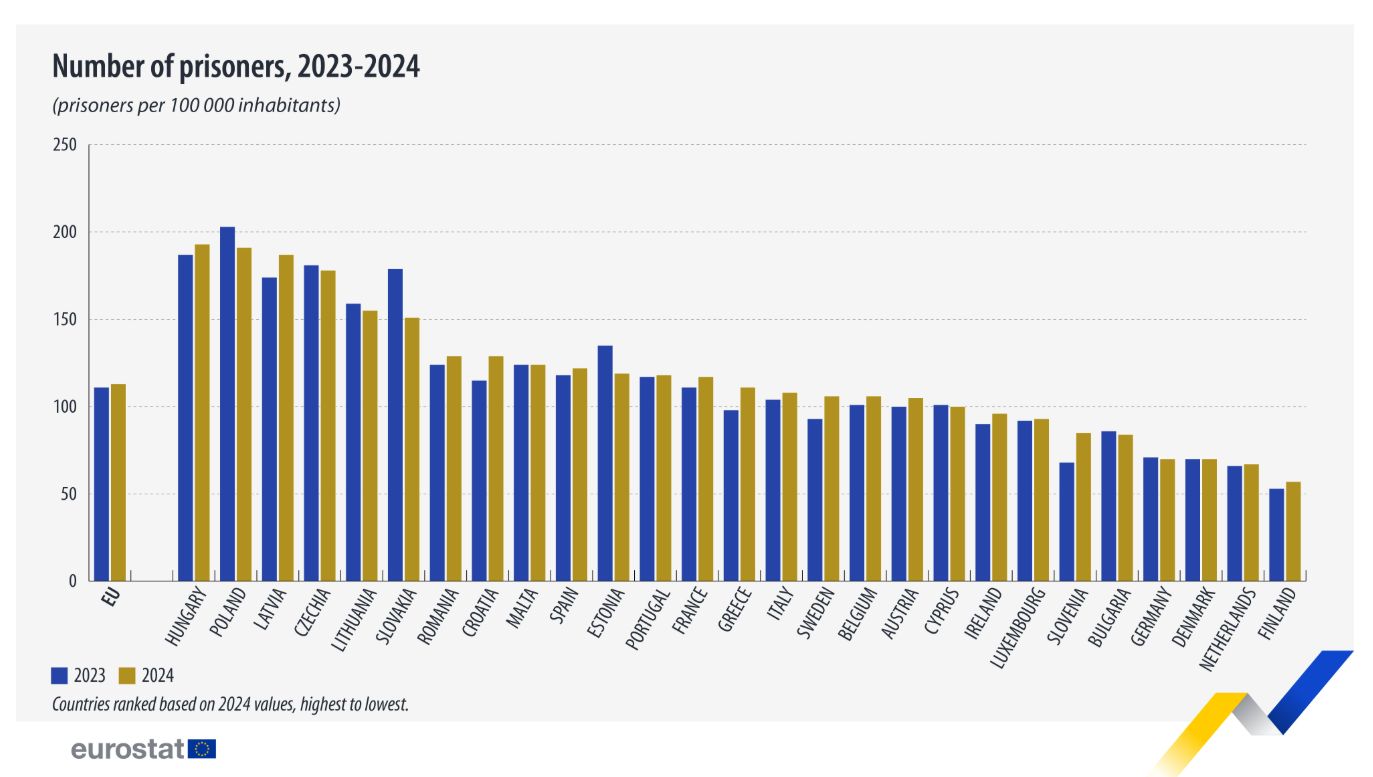
Across the EU, there were on average 113 prisoners per 100,000 people in 2024, slightly up from 111 the year before.
But the situation varies widely between countries.
Hungary recorded the highest imprisonment rate at 193 per 100,000 people, followed closely by Poland and Latvia. At the other end of the scale, Finland, the Netherlands, and Denmark reported some of the lowest incarceration rates in Europe.
One of the most striking findings, however, concerns prison overcrowding, and Cyprus stands out.
The data show that Cyprus recorded the highest prison occupancy rate in the European Union in 2024 at 227.6%, meaning prisons are holding more than double their official capacity.
In simple terms, facilities designed for one population are now holding more than twice that number of inmates.
Slovenia and France also reported significant overcrowding, while countries like Estonia and Lithuania had some of the lowest occupancy rates, well below capacity.
Overcrowding is more than just a statistic. It often translates into tougher conditions inside prisons, increased strain on staff, and challenges in rehabilitation and safety.
For Cyprus, the issue is not new, but the latest figures underline how persistent the problem has become.
While countries across Europe face different challenges, from sentencing policies to infrastructure limits, the overall picture shows a justice system under pressure in many parts of the continent.
For Cypriots, the numbers may feel distant at first glance, but the impact is closer than it seems. Overcrowded prisons can affect everything from court delays to rehabilitation programs and, ultimately, how effectively the justice system functions.
The EU data also shows that while Europe’s prison population is still below pre-2012 levels, the steady rise since 2020 suggests a shift that policymakers may need to confront more directly in the years ahead.


